


I. A Labor Market at a Crossroads
The July jobs report was supposed to be routine, a data point to reassure markets and policymakers that the U.S. economy, though cooling, remained on solid footing. Instead, it sparked a political firestorm. Hiring gains were so weak that President Donald Trump accused the Bureau of Labor Statistics (BLS) of fabricating the numbers, firing its commissioner in a move critics likened to tampering with the scoreboard rather than fixing the game.
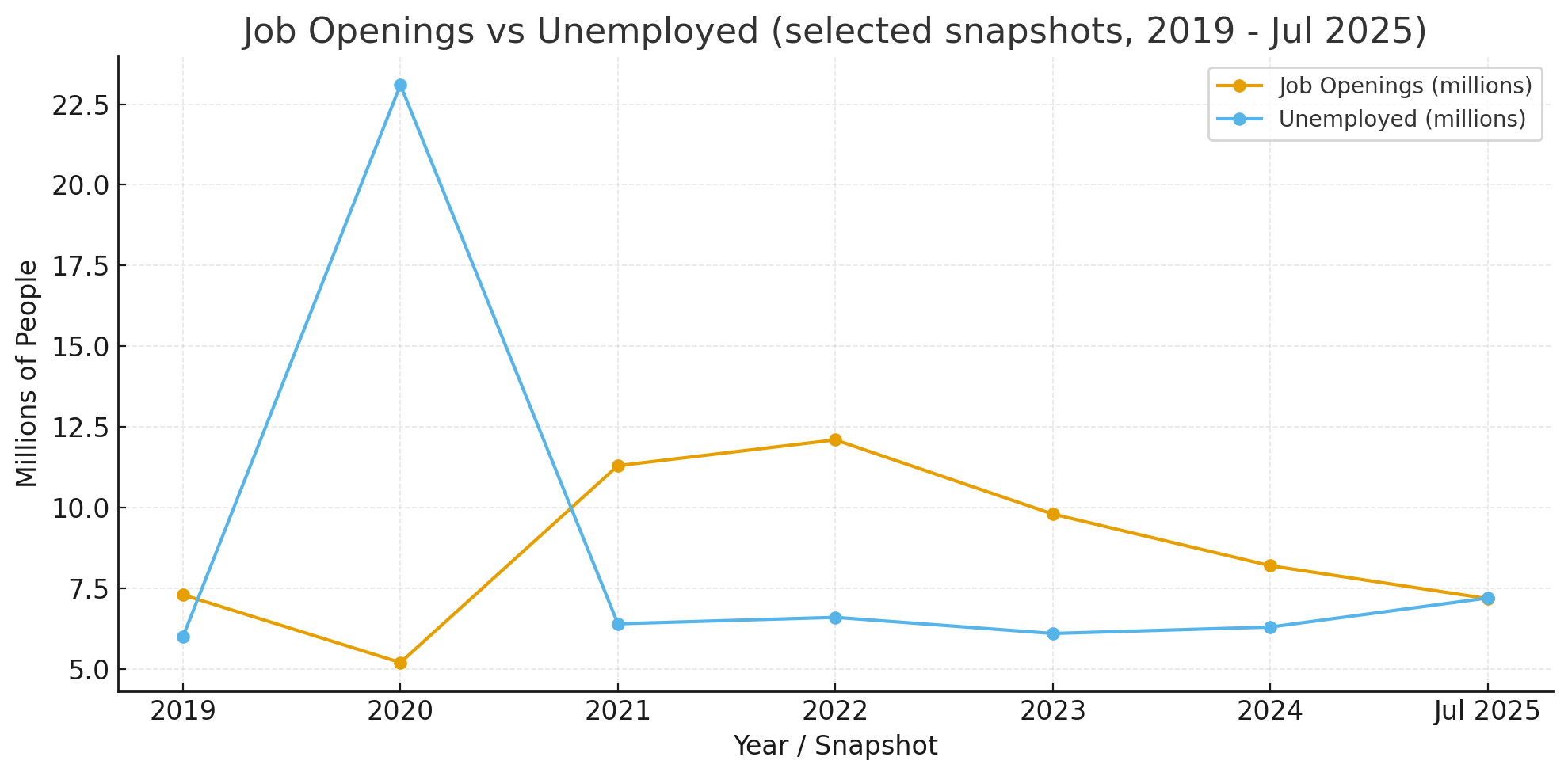
But beyond the political theater, the data itself is sobering. For the first time in more than four years, there are fewer job openings than unemployed workers: 7.18 million openings versus 7.2 million job seekers. Job openings fell by nearly 200,000 from June and sit at their lowest level in ten months.
Economists like Heather Long, chief economist at Navy Federal Credit Union, called this moment “a turning point.” The phrase is apt. For much of the post-pandemic period, openings had vastly outnumbered seekers, giving workers bargaining power unseen in decades. That balance of power has now flipped, and with it, the psychology of the labor market.
A vibrant economy requires churn—workers moving between jobs, employers competing for talent, wages climbing. Instead, July’s JOLTS (Job Openings and Labor Turnover Survey) data painted a picture of stasis: hiring flat, layoffs low, workers staying put. The churn that drives innovation, productivity, and wage growth has slowed to a trickle. A stagnant labor market is not just an economic issue—it is a political and social fault line.
II. Weakness Beneath the Surface
The labor market’s fragility is not evenly distributed. Health care and social assistance, which had been propping up employment, saw the steepest decline in openings. Leisure and hospitality, another post-pandemic growth engine, also faltered. The slowdown in these two sectors is particularly concerning because they had masked stagnation elsewhere.
Meanwhile, gains in construction, wholesale trade, and federal hiring—particularly in immigration enforcement and agencies rebuilding staff after deep Trump-era cuts—were too narrow to offset broader softness.
This concentration of job growth in a few industries creates brittleness. In a diversified economy, a slowdown in one sector can be absorbed by growth in others. Today, the labor market’s health hinges disproportionately on health care and hospitality, sectors vulnerable to both consumer demand shifts and government policy.
Equally troubling is the decline in labor turnover. Economists such as Allison Shrivastava of Indeed emphasize that churn is not a sign of instability but of vitality. When workers move, wages rise, and productivity improves. Stagnation—workers locked in place, firms reluctant to hire—saps innovation and depresses wage growth.
III. A Data-Driven Look at Wages vs. Inflation
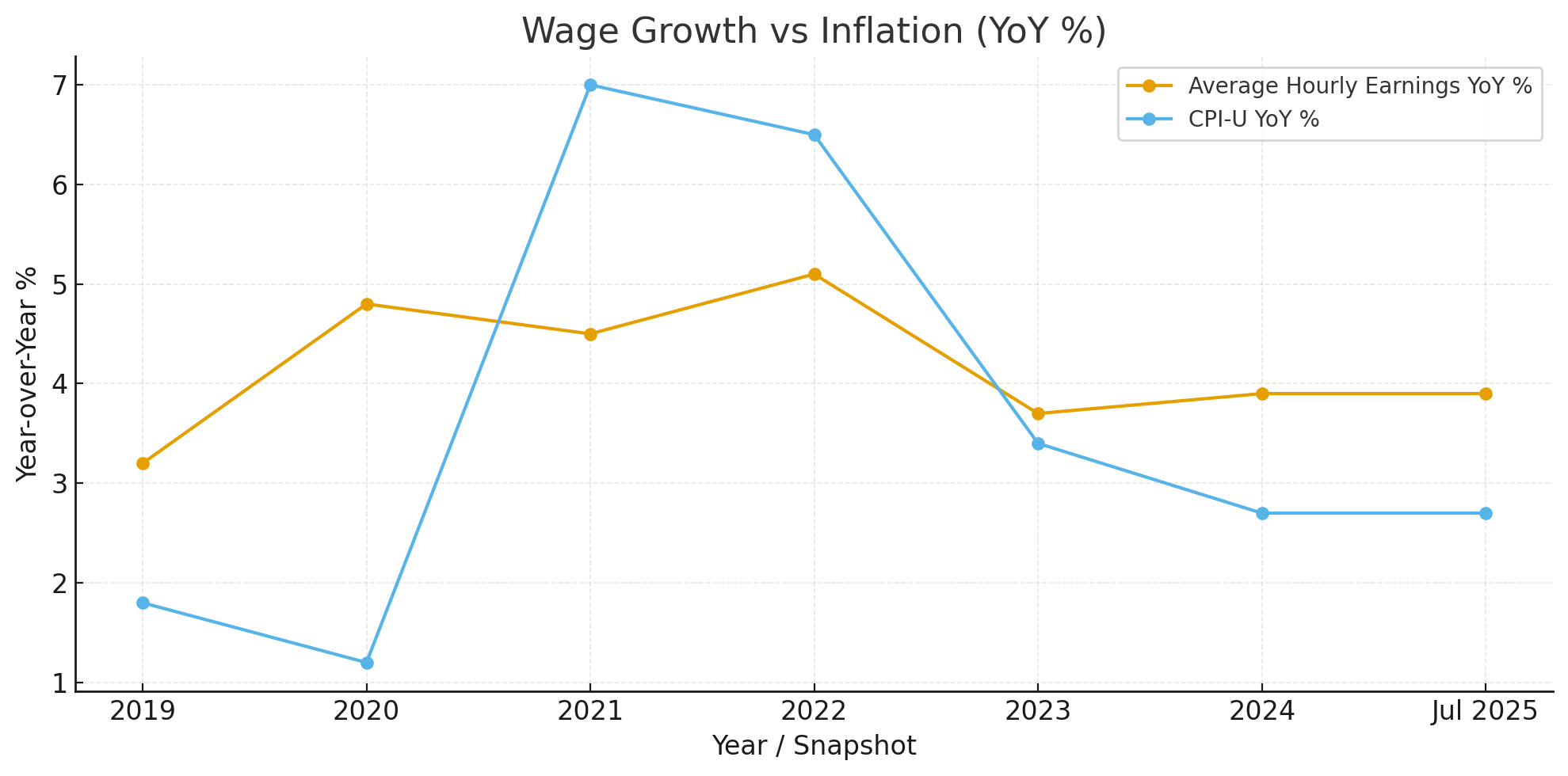
The labor slump comes at a time when wage dynamics are already under stress. In nominal terms, wages have continued to rise. Average hourly earnings increased by roughly 4.1% year-over-year in July 2025, according to BLS data. On the surface, that looks healthy.
But the inflation backdrop changes the picture. With consumer prices rising at about 3.3% annually (as of July 2025, per the Consumer Price Index), real wage growth—wages adjusted for inflation—is effectively flat, around 0.8%. Compare that to the pandemic years of 2021–22, when inflation wiped out wage gains entirely, and you might see progress. Yet for workers feeling the squeeze of housing, energy, and health care costs, a sub-1% gain is barely noticeable.
Consider this contrast:
- 1970s stagflation: Wages rose quickly, but inflation outpaced them, eroding real incomes.
- 2010s recovery: Inflation was low, but wage growth was sluggish, keeping real wages stagnant.
- Today: Nominal wages are higher than in the 2010s, but inflation remains sticky. The result is a middle ground—neither stagflation’s collapse in real earnings nor the 2010s’ stagnation, but something more insidious: slow erosion.
Workers may not be losing ground as dramatically as in the 1970s, but they are not meaningfully advancing either. In political terms, that distinction matters little. To households balancing grocery bills and mortgage payments, the perception of stagnation is indistinguishable from decline.
IV. The European Mirror: Parallel Stagnation
The U.S. is not alone in facing a labor market caught between cooling demand and persistent inflation. Europe, too, is grappling with stagnation—though its dynamics differ.
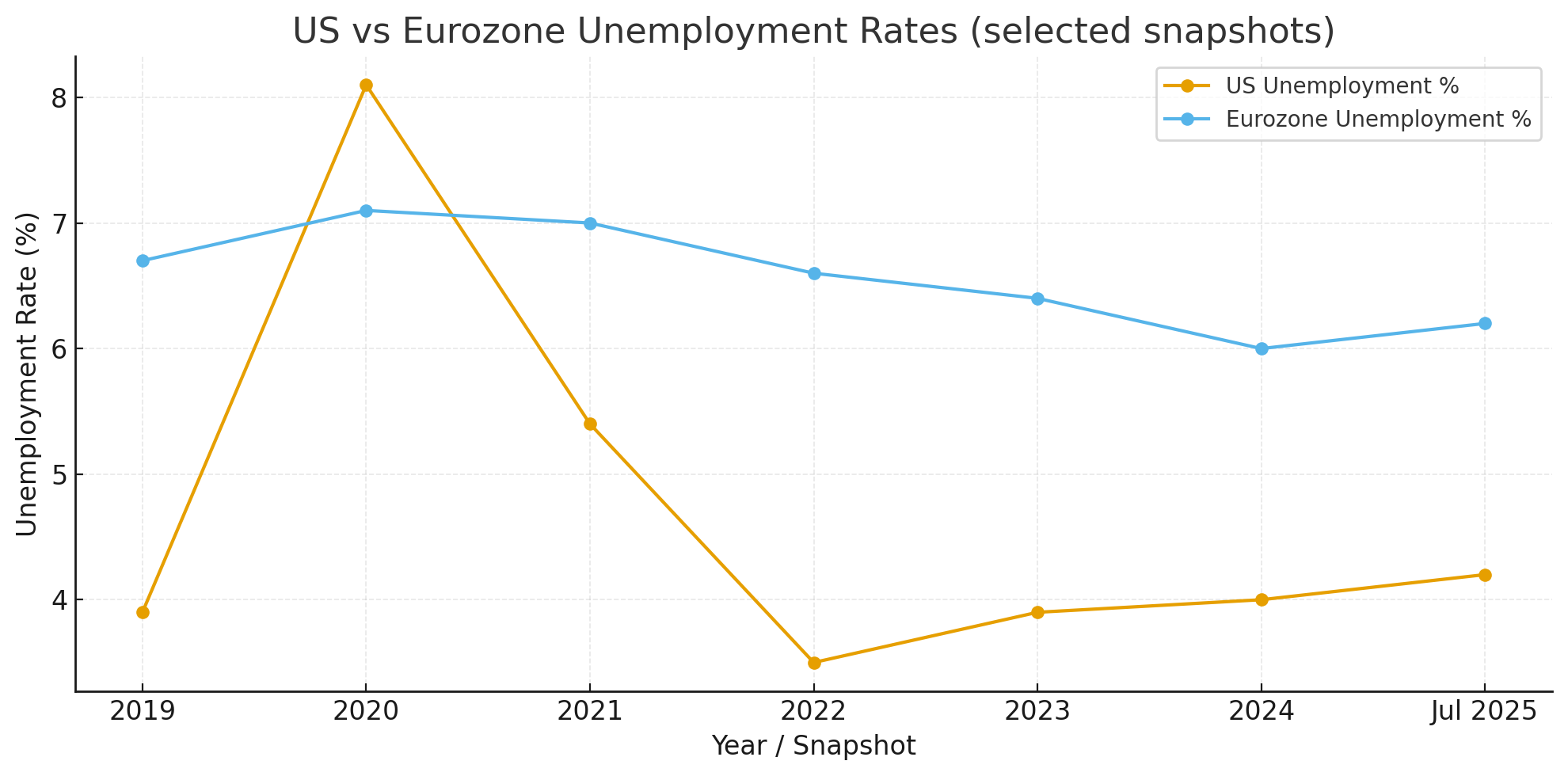
Across the eurozone, unemployment remains historically low, at around 6.4% in July 2025 (Eurostat data). Yet labor force participation is stagnant, and wage growth lags inflation in several major economies. Germany, once Europe’s industrial powerhouse, has seen real wages fall in three of the past four years. France has avoided outright declines, but wage growth barely matches inflation, leaving households squeezed.
The European Central Bank (ECB) has kept interest rates elevated to tame inflation, mirroring the Federal Reserve’s strategy. The result has been a cooling of investment and hiring. Like the U.S., Europe is increasingly reliant on health care, education, and government employment to sustain job growth. Meanwhile, energy shocks from the war in Ukraine and the global green transition have placed additional strain on traditional industries.
A key distinction lies in Europe’s social-market model. Countries like Germany and the Netherlands cushion stagnation through stronger safety nets—unemployment benefits, retraining programs, and wage subsidies. This does not eliminate pain, but it blunts the impact compared to the U.S., where workers rely more heavily on market outcomes.
Yet Europe’s experience offers a warning: social buffers can mask underlying structural weaknesses but not resolve them. Even with generous benefits, a labor market that lacks churn and innovation risks long-term sclerosis.
V. Lessons from the 1970s: The Shadow of Stagflation
To understand today’s slump, it helps to revisit the 1970s, when the U.S. faced one of its most painful labor-market crises. Then, as now, unemployment and inflation presented a paradox. Inflation surged due to oil shocks and loose monetary policy, while unemployment climbed as industries shed jobs. The result was stagflation—simultaneous stagnation and inflation, a phenomenon economists had long considered impossible.
The 1970s labor market was characterized by:
- Erosion of real wages – Nominal paychecks rose, but inflation devoured purchasing power.
- Sectoral decline – Manufacturing jobs collapsed, exposing a mismatch between skills and opportunities.
- Political turmoil – Disillusionment with institutions deepened as government solutions seemed ineffective.
Today, the echoes are striking but not identical. Inflation is elevated but not runaway. Unemployment remains low compared to the double-digit levels of the 1970s. And yet, the core challenge is similar: how to sustain real income growth in an economy buffeted by structural change.
One lesson stands out. The Federal Reserve eventually tamed inflation in the 1980s under Paul Volcker, but only at the cost of a brutal recession that pushed unemployment above 10%. If today’s policymakers fail to manage the balance between inflation and employment, the U.S. could face a softer but prolonged version of that dilemma: stagnant wages, cooling demand, and eroded trust in government.
VI. The Politics of Jobs and Data
The firing of the BLS commissioner underscores another challenge: the politicization of economic statistics. The BLS has been trusted for decades as a neutral arbiter of data. Undermining its credibility risks creating an environment where no one believes official figures, a dangerous precedent in a democracy.
It is not the first time labor data has been politicized. In 2012, conservative commentators accused the Obama administration of manipulating unemployment numbers before the election. Each time such claims surface, institutional trust erodes. But today’s political climate is even more polarized, and labor data is more volatile. That volatility feeds conspiracy theories more easily, making it harder for the public to distinguish real weakness from political spin.
VII. The Road Ahead: Reinvention or Stagnation?
America’s labor market has reinvented itself before. After the collapse of manufacturing in the 1980s, services and technology became the new engines of growth. After the Great Recession, gig work and digital platforms reshaped employment. After the pandemic, remote work and flexible arrangements expanded opportunities.
The question is whether the current slump will trigger another reinvention—or whether the economy will settle into stagnation disguised as stability.
Three scenarios loom:
- Soft Landing: Inflation continues to cool, wage growth stabilizes, and job openings rebound modestly. This would resemble Europe’s slower but steadier labor model.
- Stagflation 2.0: Inflation remains sticky while job growth stalls further. Real wages stagnate or decline, reviving the worst dynamics of the 1970s.
- Reinvention: New industries—AI, green energy, advanced manufacturing—absorb displaced workers and create churn, reviving labor dynamism. This requires aggressive investment in training and infrastructure.
The difference between these outcomes will depend on policy choices. Will the government invest in reskilling workers and diversifying industries, or will it rely on narrow subsidies that entrench corporate power? Will leaders restore trust in data, or politicize it further? Will workers be given mobility and security, or locked in place by stagnation?
VIII. Conclusion: Beyond the Numbers
The July JOLTS report may have looked like a technical data release, but it marked something larger: the end of a labor market era defined by worker leverage. The U.S. now faces a test of whether it can engineer another reinvention, or whether it drifts into a future of low churn, stagnant wages, and brittle growth.
Comparisons to Europe highlight that America’s more market-driven model lacks social buffers, but Europe’s stagnation proves that safety nets alone are not enough. Historical echoes of the 1970s warn that without bold action, the economy could slide into prolonged malaise.
The stakes are high. A dynamic labor market is not just about numbers—it is about opportunity, mobility, and trust. Lose those, and what follows is not just economic weakness but social fracture. America’s jobs slump is real. The question is whether it becomes a passing slowdown, or the beginning of something much deeper.




