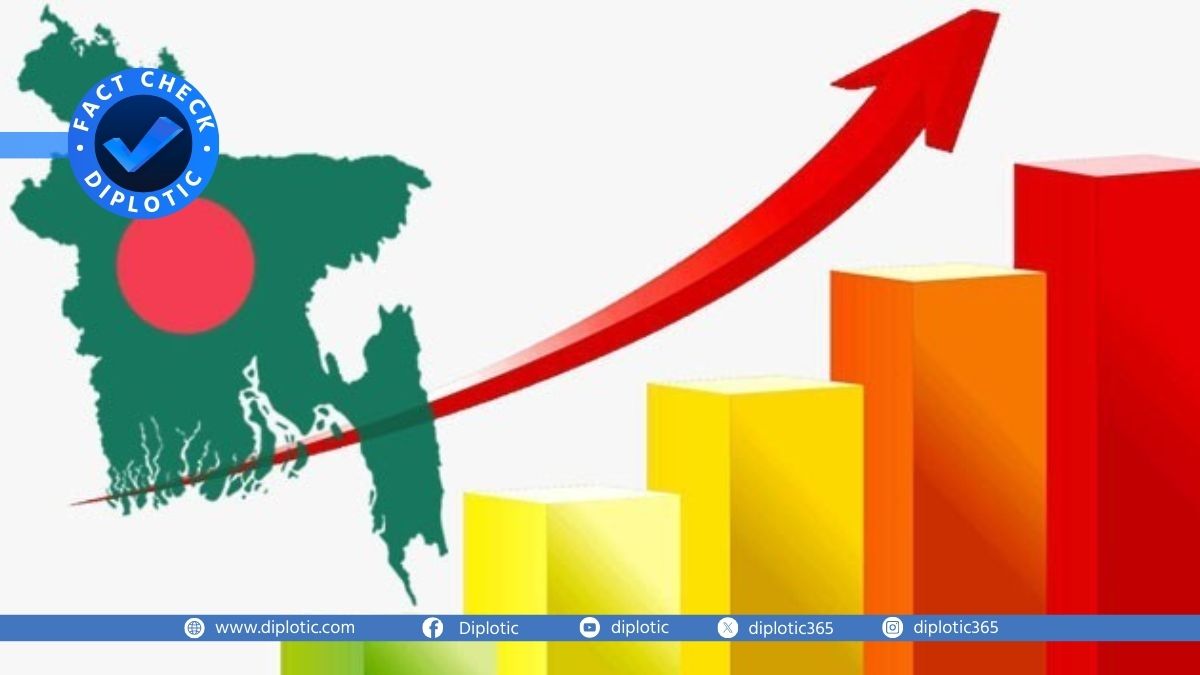
In conference rooms from Dhaka to Davos, a bold claim has begun to echo: Bangladesh is the next Asian Tiger. It’s a phrase laced with ambition, optimism, and the heavy weight of history. On paper, the numbers dazzle—6% average growth over a decade, a $470 billion economy, a booming garment industry, and glittering new ports rising from the silted rivers of the delta. From Western think tanks to South Asian newsrooms, the comparisons to South Korea, Singapore, Taiwan, and Hong Kong—the original “Tigers” of 20th-century miracle growth—have gained traction.
But beneath the headlines lies a more complicated story.
Diplotic dives deep into the claim, stripping away PR gloss and government press kits to test the evidence behind the roar. Is Bangladesh truly pacing toward tigerhood—or is it sprinting on a treadmill of vulnerabilities, illusions, and one-sector dependence? This fact-check examines four key claims fueling the narrative, measuring them against hard data, historical parallels, and structural realities.
Because not every fast-growing cub becomes a tiger.
Claim 1: Bangladesh’s Economic Growth Rivals That of the Original Asian Tigers
Fact-Check: Partially True
Bangladesh has posted impressive growth, with an average annual GDP growth rate of 6% over the past decade, peaking at 7.3% in 2024 before dipping to 4.2% in FY24 due to global uncertainties and domestic issues. The Asian Development Bank projects a rebound to 3.9% in FY25 and 5.1% in FY26, while the World Bank anticipates 4.2% growth in 2025 amid tariff pressures. This growth outpaces India’s recent slowdown and Pakistan’s stagnation, with per capita income crossing the lower middle-income threshold in 2015 and exceeding Pakistan’s since 2006. The original Tigers averaged 8–10% growth during their peak decades, driven by manufacturing and exports.
However, Bangladesh’s growth is narrower, heavily reliant on the garment sector, which accounts for over 84% of exports ($8.4 billion to the U.S. in 2024). The Tigers diversified into electronics, shipbuilding, and services, while Bangladesh’s industrial base remains less varied, with agriculture and remittances ($23 billion in 2025) playing significant roles. The 36.5% U.S. tariff since August 1, 2025, has cut exports by 8%, signaling vulnerability. Growth is robust but lacks the breadth and speed of the Tigers’ peak.
Verdict: The claim is partially true. Bangladesh’s 6% average growth rivals regional peers and exceeds historical lows, but it falls short of the Tigers’ 8–10% peak and lacks their diversification, making the comparison incomplete.
Claim 2: Bangladesh Has the Structural Foundations to Become an Asian Tiger
Fact-Check: Partially True
Bangladesh boasts strengths aligning with tiger economies. Its 169 million population, with a young workforce (median age 27), fuels a labor force growth of 2% annually, supporting industrialization. Literacy rates have risen to 74% (2025 estimate), and life expectancy reached 72 years, surpassing India and Pakistan. Mega projects like Matarbari and Payra deep-sea ports, nearing completion by 2025, enhance trade connectivity with India, China, and ASEAN. Remittances and a 12% EU export rise in 2025 bolster resilience. The government targets a top-25 global economy by 2030 and high-income status by 2041.
Yet, structural weaknesses persist. Infrastructure lags, with poor roads and 20% of the population off the power grid, forcing firms to use backup generators. Corruption ranks high, and regulatory inefficiencies deter investment. The garment sector’s dominance exposes it to global shocks, like the August 2025 tariffs, while diversification into high-value sectors like electronics remains nascent. The Tigers built robust infrastructure and legal systems early, which Bangladesh has yet to fully replicate.
Verdict: The claim is partially true. Bangladesh has a young workforce, strategic location, and growth potential, but inadequate infrastructure, corruption, and limited diversification hinder its tiger trajectory.
Claim 3: Bangladesh’s Economic Resilience Matches That of Past Tiger Economies
Fact-Check: False
Bangladesh showed resilience during the COVID-19 pandemic, growing 5% in 2020–21, and weathered the 2025 tariff hike with a 12% EU export surge and $23 billion in remittances. Political stability, despite the July 2025 unrest and Sheikh Hasina’s resignation, has partially recovered, with industrial activity up 1.5% in July 2025. Poverty dropped from 31.5% to 23.2% (2010–2025), lifting 15 million people, and human development indices outpace India and Pakistan.
Contrast this with the Tigers, who survived the 1997 Asian financial crisis and 2008 global recession with diversified economies and strong financial systems. Bangladesh’s 8% export drop and 247,500 job losses from tariffs highlight reliance on a single sector. Climate change, with recurring floods, and a 3.5% trade deficit in 2025 add pressure. The Tigers’ resilience stemmed from broader industrial bases and fiscal buffers, which Bangladesh lacks.
Verdict: The claim is false. Bangladesh demonstrates resilience through remittances and export shifts, but its narrow economic base and external vulnerabilities fall short of the Tigers’ proven durability.
Claim 4: Bangladesh Is on Track to Join the Ranks of Modern Tiger Economies
Fact-Check: Partially True
Emerging economies like Vietnam (6% growth, $450 billion GDP in 2025), Indonesia (5–6% growth, $1.5 trillion GDP), and the Philippines (6% growth, $471 billion GDP) are modern tiger candidates, driven by diversified manufacturing, tech, and services. Bangladesh’s $470 billion GDP and 4.2% projected growth in 2025 lag behind, but its 6% decade-long average and $500 billion economy target for 2025 suggest potential. FDI is rising, and deep-sea ports could boost trade.
Progress is tempered by challenges. Vietnam’s tech sector and Indonesia’s resource diversification outpace Bangladesh’s garment focus. Political instability post-July 2025 and a 17% market cap-to-GDP ratio (versus 50–60% in China or Brazil) indicate untapped but underdeveloped capital markets. The Tigers and modern peers built export variety and stability faster, while Bangladesh’s path remains fragile.
Verdict: The claim is partially true. Bangladesh shows promise with growth and infrastructure, but its slower diversification and recent instability place it behind modern tiger contenders.
A Rising but Unproven Tiger
Bangladesh’s journey from a “bottomless basket” in 1971 to a $470 billion economy by 2025 reflects export-led growth, a young workforce, and social gains like female empowerment (33.6% labor participation). The garment sector, remittances, and EU market shifts cushion the 36.5% U.S. tariff impact, but an 8% export drop and 247,500 job losses signal risks. Compared to the Tigers’ diversified industrialization and modern peers’ tech advances, Bangladesh’s economy is narrower and more vulnerable to climate and political shocks. Its 4.2% growth projection and infrastructure push offer hope, but the “next Asian Tiger” label awaits broader economic depth.
They call Bangladesh the next Asian Tiger, with its 6% growth and shiny ports. Sure, it’s outpacing Pakistan and lifting millions, but one tariff cut exports 8% and costs 247,500 jobs. The Tigers had tech and steel; we’ve got shirts and floods. Remittances and EU orders keep us afloat, but one big storm or coup, and it’s back to square one. Nice try, but not there yet.
“They’re building ports, but my village still floods every year,” I mutter, eyeing the headlines.
Conclusion
Bangladesh is not yet the “next Asian Tiger” but shows potential. Its 6% average growth and social progress rival regional peers, yet it lags the original Tigers’ 8–10% peak and diversification. Structural flaws—poor infrastructure, corruption, and garment reliance—plus a 4.2% growth projection amid 2025 tariffs and instability, temper the claim. Resilience exists, but vulnerability to external shocks and slower diversification place it behind modern tiger economies like Vietnam. With reforms, it could approach tiger status, but as of August 7, 2025, it remains a rising contender.