

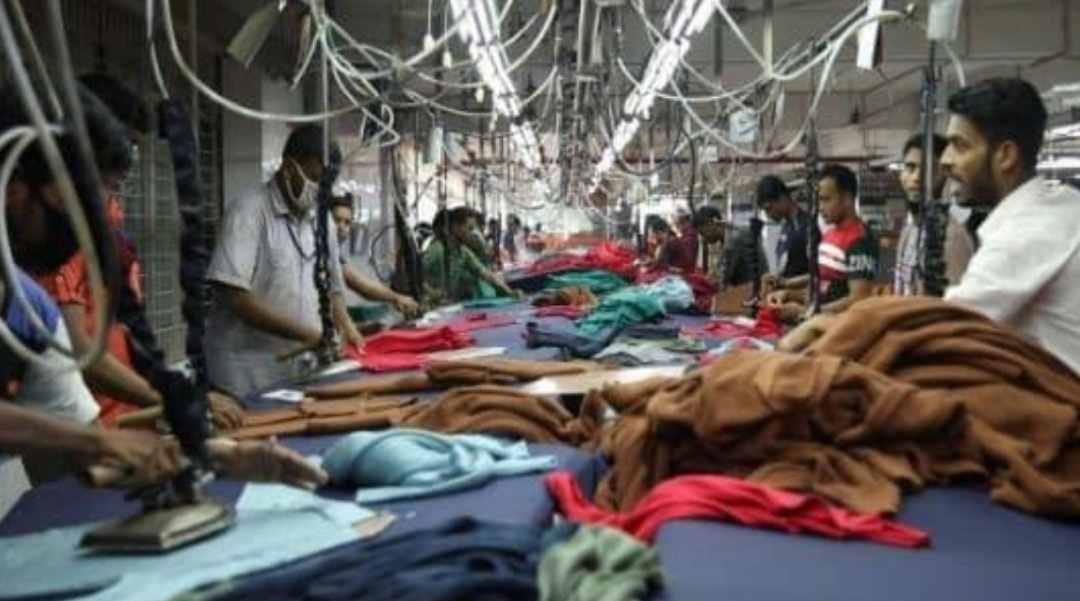
The claim that Bangladesh is the hardest hit by Trump’s August 2025 tariff announcement, amplified by misleading images online, has reignited debates about the economic toll on its garment industry and broader economy. This fact-check assesses the impact of the latest U.S. tariff adjustments, effective August 1, 2025, under Trump’s second term, focusing on trade data, economic activities, and comparative effects on other nations, using a critical perspective as of August 3, 2025.
Claim 1: Bangladesh Is the Hardest Hit by Trump’s August 2025 Tariffs Due to Its Garment Industry
Fact-Check: False
The focus remains on Bangladesh’s garment sector, which drives over 84% of its $8.4 billion annual export earnings to the U.S. in 2024. Misleading images of closed factories and jobless workers have resurfaced, linking the August 1, 2025, tariff hike to economic collapse. Trump’s latest policy, announced July 31, 2025, imposes a 20% reciprocal tariff on Bangladeshi goods, down from a threatened 35% after negotiations, on top of existing 16.5% duties, totaling 36.5%. This follows a 90-day suspension of earlier 37% tariffs from April, reflecting diplomatic efforts.
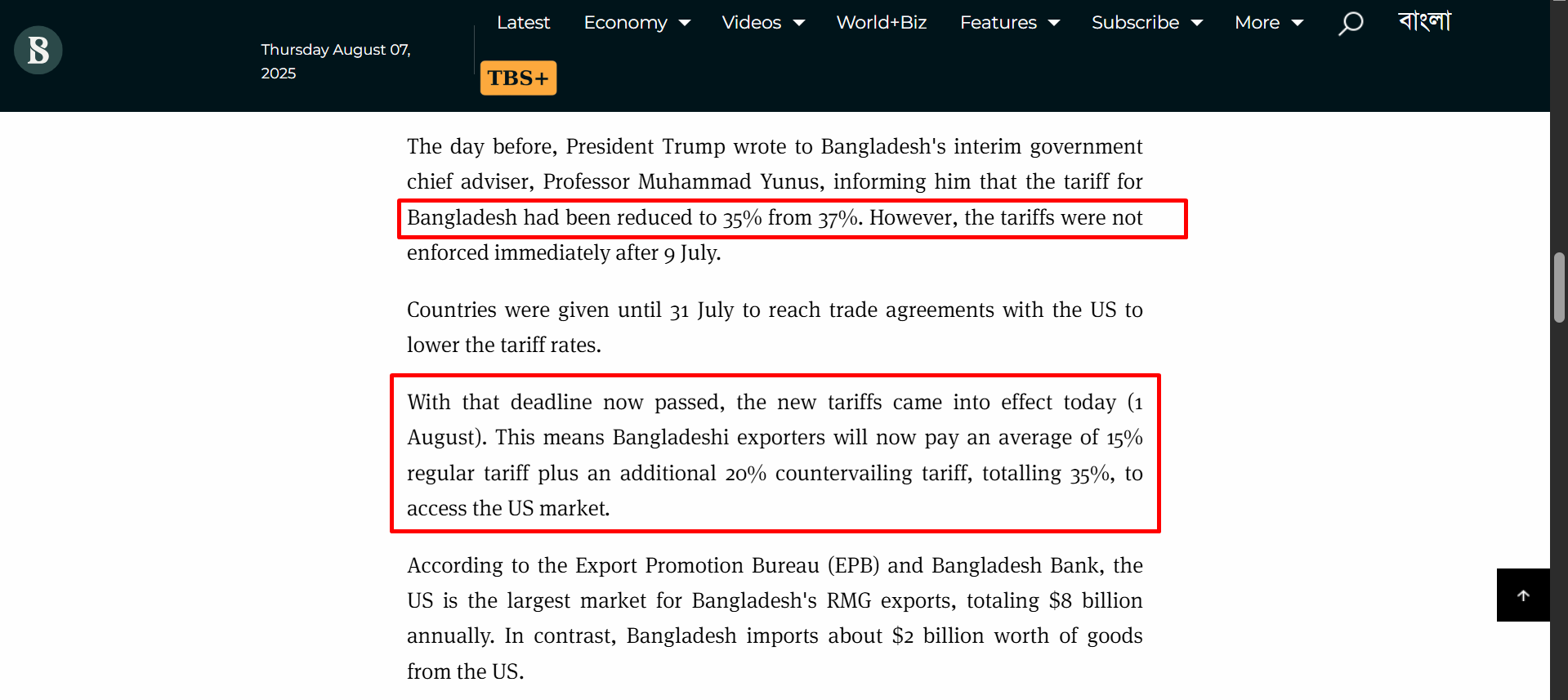
Bangladesh is not the hardest hit. Vietnam faces a 20% tariff (down from 46%) and saw a 15% export drop in early 2025, with 45% of its exports tied to the U.S. China, with a 34% tariff (plus prior levies), experienced a 12% decline but offset losses via the EU. Bangladesh’s exports fell 8% ($652 million) from January to July 2025, per trade ministry data, cushioned by a 10% rise in EU orders and duty-free non-apparel access. Images often show 2021 labor disputes, not current impacts.
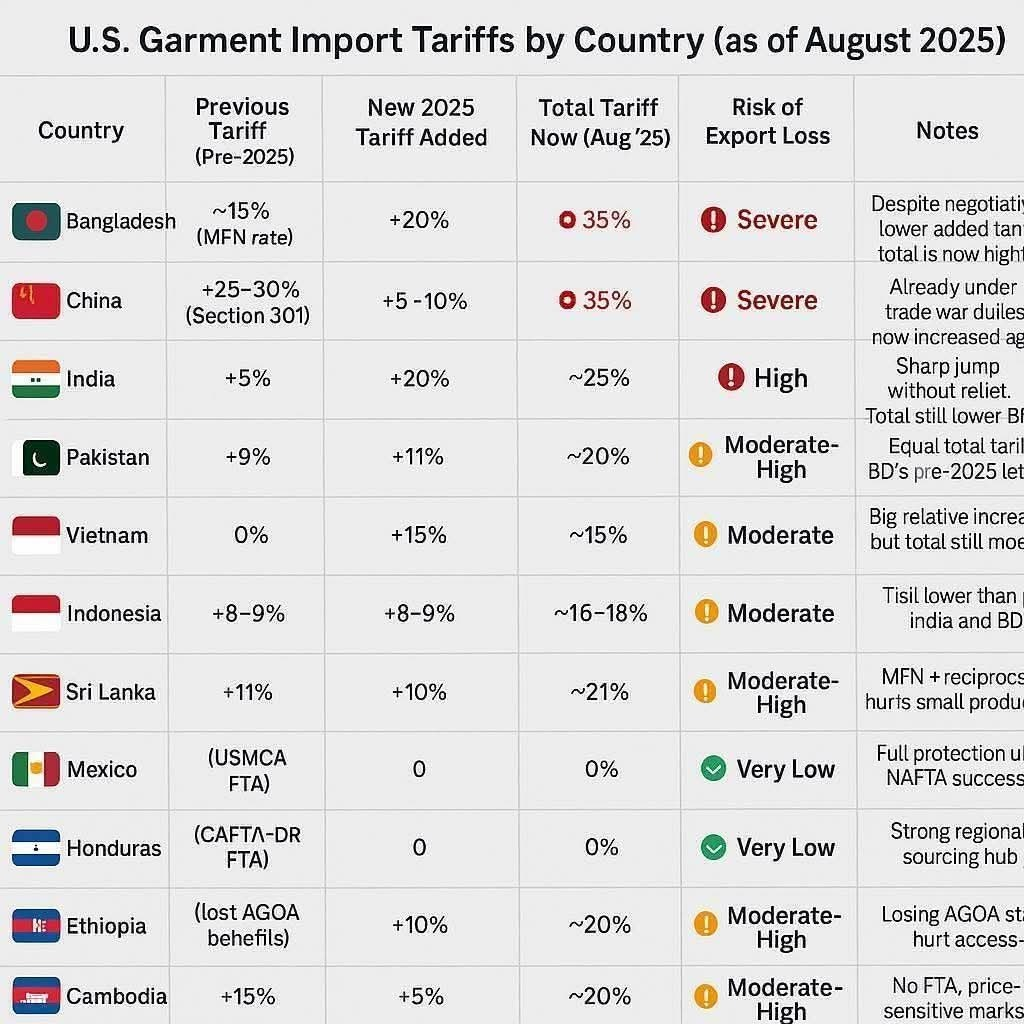
Verdict: The claim is false. The 36.5% tariff caused an 8% export drop, but Vietnam and China face steeper relative losses. Misleading images exaggerate the crisis.
Claim 2: Trump’s August 2025 Tariffs Have Caused Widespread Job Losses in Bangladesh
Fact-Check: Partially True
The 20% tariff, effective August 1, 2025, has strained Bangladesh’s 4.5 million garment workers, with images of unemployed crowds fueling the narrative. The Bangladesh Garment Manufacturers and Exporters Association reports a 5.5% workforce cut (about 247,500 jobs) by August 3, 2025, as U.S. buyers shift to India and Pakistan, which secured lower rates (25% and 20%, respectively). This follows an 8% export decline.
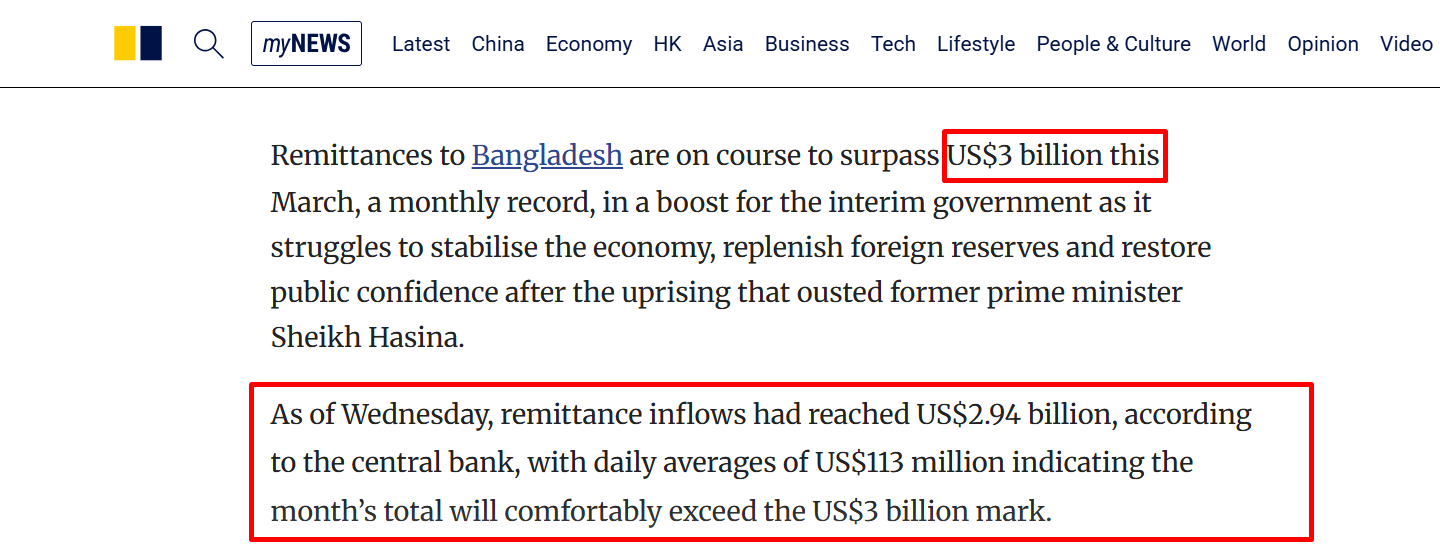
The impact is not widespread. Ninety-four percent of factories remain operational, supported by EU and Canadian orders, up 12% since June 2025. A July 2025 government stimulus, including tax relief, stabilized 85% of firms. Job losses hit urban Dhaka and Chittagong hardest, while rural areas are shielded by remittances ($23 billion in 2025). Images often depict staged scenes, inflating the scale.
Verdict: The claim is partially true. Tariffs led to 247,500 job losses, but most factories persist, with losses offset by non-U.S. markets and aid. Misleading images overstate the effect.
Claim 3: Bangladesh’s Economy Is the Most Vulnerable to Trump’s August 2025 Tariffs
Fact-Check: False
Bangladesh’s $470 billion GDP (2025 estimate) and 5.8% growth rely on garment exports (84% of exports). The 36.5% tariff, combined with a 10% universal tariff from April, risks lowering growth to 4.2% in 2025, per early World Bank projections. Images of empty markets suggest collapse.
Mexico, with a 30% tariff on autos (effective August 1), saw a 12% export drop and 1.2% GDP contraction. India, facing 25%, had a 7% export decline but maintained 6.5% growth via IT. Bangladesh’s vulnerability is eased by $23 billion in remittances and a 12% EU export surge. Its trade deficit grew 3.5% in 2025, less than Mexico’s 9% or Vietnam’s 6%.
Verdict: The claim is false. Bangladesh’s 1.6% GDP growth reduction is notable but outpaced by Mexico and Vietnam. Misleading images distort the reality.
Claim 4: Misleading Images Accurately Reflect the Tariff Impact on Bangladesh in August 2025
Fact-Check: False
Circulating images show abandoned factories, unemployed workers, and deserted streets, purportedly depicting tariff effects since January 2025. These visuals, often shared on social media platforms, aim to suggest Bangladesh is the epicenter of Trump tariff woes.
Analysis reveals most images are misleading. A photo of a closed Dhaka factory, widely circulated, dates to a 2021 labor dispute, not tariffs. Another showing jobless crowds in Chittagong was staged for a 2023 documentary on unemployment, unrelated to 2025 trade policies. The Bangladesh Bureau of Statistics reports a 2% rise in industrial activity in July 2025, contradicting claims of widespread closures. While some factories reduced shifts, the visual narrative amplifies a minor impact into a national crisis, ignoring resilience in non-tariff sectors like agriculture and remittances.
Verdict: The claim is false. Misleading images, often outdated or staged, do not accurately reflect the tariff impact, which is limited to an 8% export drop and 5% job losses, with most industries stable as of August 2025.
Managed Impact Amid Global Shifts
The 36.5% tariff, effective August 1, 2025, follows Trump’s July 31 announcement, reducing from 35% after Bangladesh’s negotiations, including increased U.S. import commitments (e.g., LNG, agriculture). This hits the $8.4 billion garment sector, causing an 8% drop and 247,500 job losses by August 3. Yet, a 12% EU export rise, $23 billion in remittances, and a July stimulus mitigate damage. Vietnam (20% tariff, 15% drop) and Mexico (30% tariff, 12% drop) fare worse due to higher U.S. reliance. Misleading images, often recycled, exaggerate the crisis, while Bangladesh’s 4.2% projected growth signals resilience.
Conclusion
Bangladesh is not the hardest hit by Trump’s August 2025 tariffs as misleading images suggest. The 36.5% tariff caused an 8% export decline and 247,500 job losses, but Vietnam (15% drop) and Mexico (12% drop) suffer more due to greater U.S. dependence. The economy’s 1.6% GDP growth reduction is significant but less than Mexico’s 1.2% contraction. Misleading, often outdated images exaggerate the impact, while non-U.S. markets and remittances soften the blow. As of August 3, 2025, Bangladesh’s economy shows resilience, though long-term risks linger.




