

In recent past, rumors and social media posts have ignited a popular claim: that Bengali (Bangla), one of the most spoken languages in the world, has finally been declared an official language of the United Nations. The claim taps into deep national pride, given the language’s historic legacy, cultural weight, and the longstanding diplomatic push by Bangladesh for global recognition.
But is this claim true, or just aspirational?
This fact-check investigates whether Bengali has indeed gained official language status at the UN. We examine the current list of UN official languages, Bangladesh’s advocacy efforts over the years, and the global linguistic influence of Bengali. We also explore related claims about its official use in other countries and international forums.
Backed by credible UN documentation, diplomatic records, and language policy reports, this analysis seeks to separate symbolic ambition from official fact—and to clarify where Bengali currently stands on the world stage.
Claim 1: Bengali Was Declared an Official Language of the United Nations
Fact-Check: False
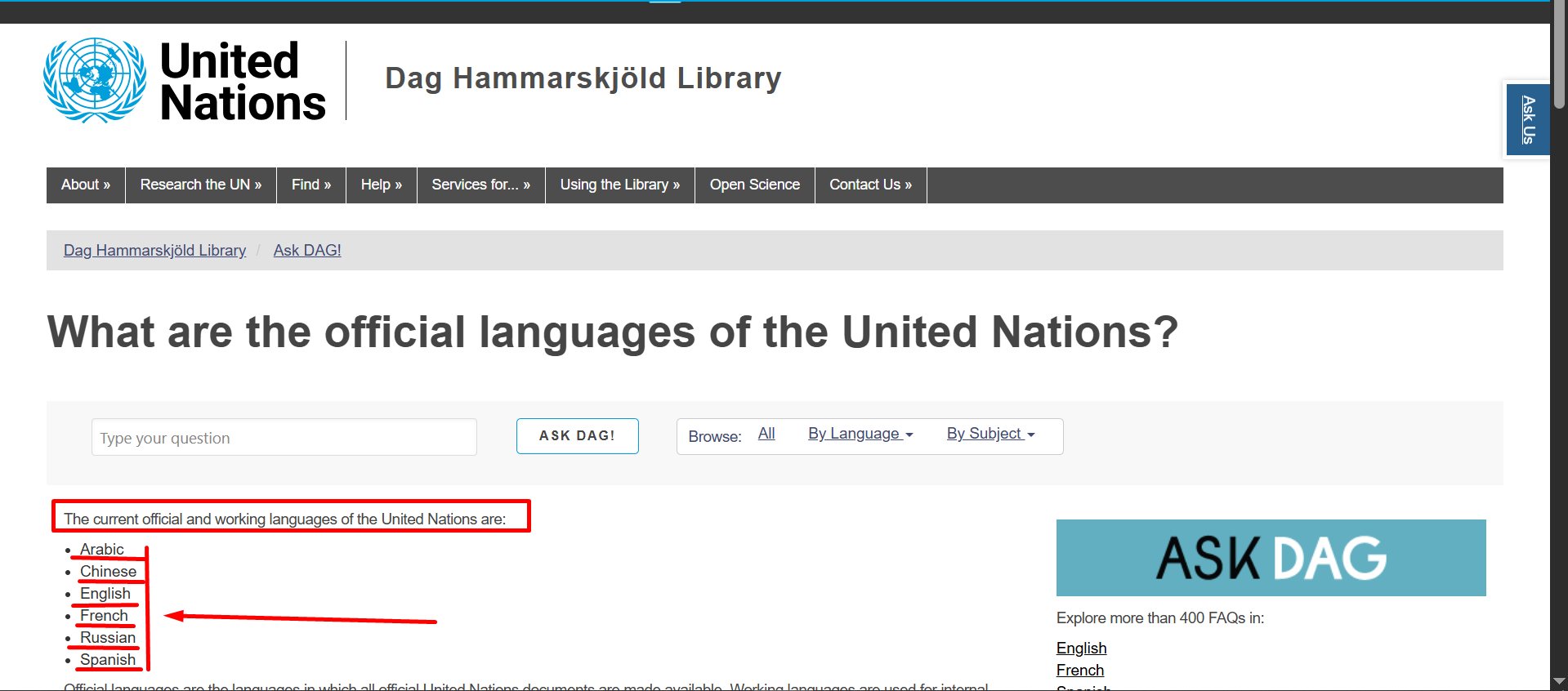
Bengali has not been declared an official language of the United Nations. The UN currently recognizes six official languages: Arabic, Chinese, English, French, Russian, and Spanish, as established by the UN Charter in 1946 and subsequent resolutions, with Arabic added in 1973 (UN Official Languages, Wikipedia, 2010). These languages are used for all official UN documents, meetings, and simultaneous interpretation (UN Official Languages, www.un.org, 2025). Despite repeated proposals from Bangladesh, no resolution has been adopted to include Bengali as an official UN language.
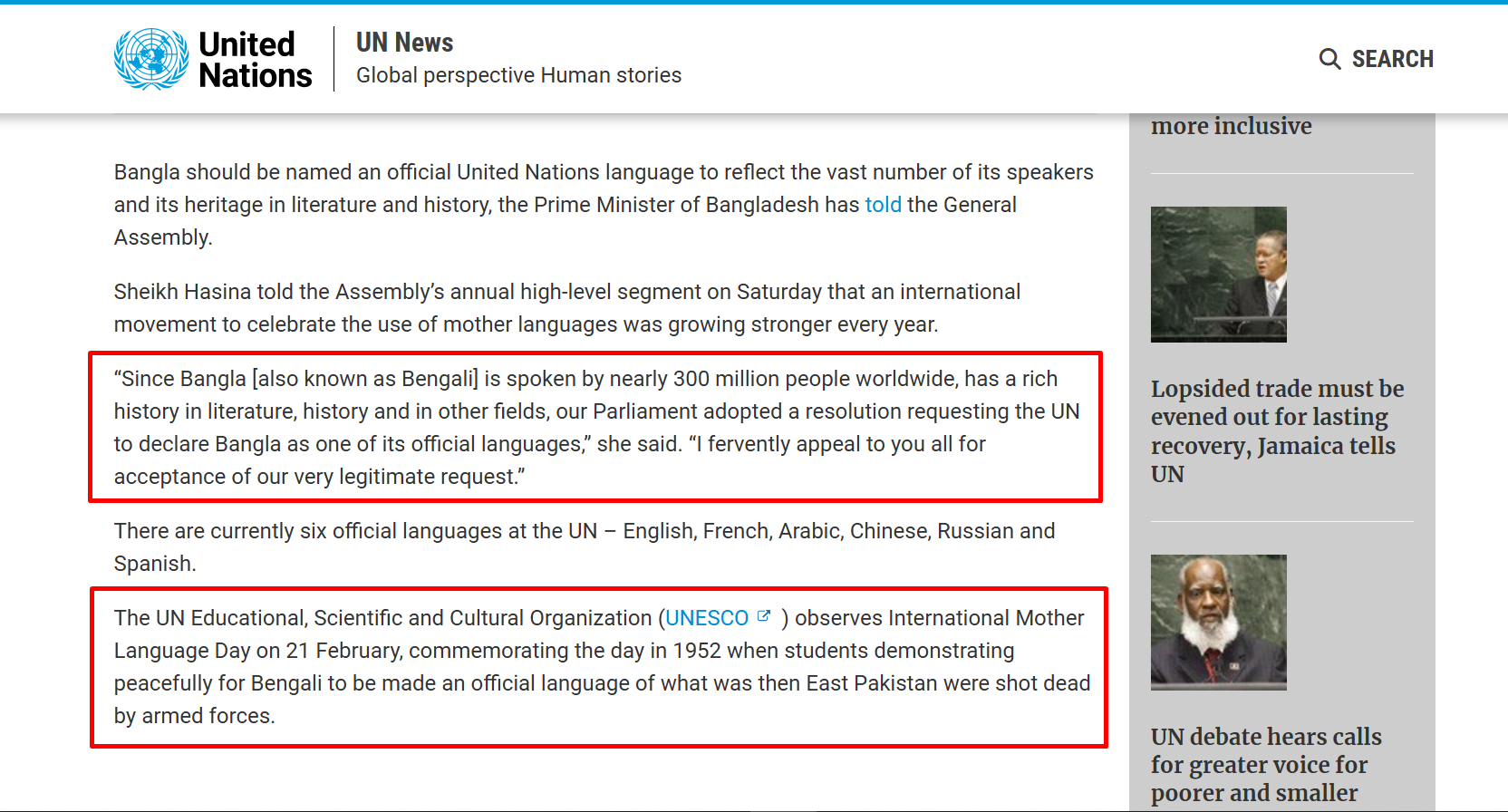
Advocacy for Bengali’s inclusion began notably in 2009, when Bangladesh’s Parliament and India’s West Bengal assembly passed resolutions urging the UN to recognize Bengali as an official language, citing its 300 million speakers and rich literary heritage (BBC News, 2009; UN News, 2010). In 2010, Prime Minister Sheikh Hasina reiterated this request at the UN General Assembly, emphasizing Bengali’s global speaker base and cultural significance (UN News, 2010). Similar calls were made in 2012, 2021, 2023, and 2024 by Bangladeshi officials, including Foreign Minister Hasan Mahmud, who described it as a “national dream” (Dhaka Tribune, 2024; The Daily Star, 2024). A 2022 UN General Assembly resolution, sponsored by India, encouraged the use of non-official languages like Bengali, Hindi, and Urdu for disseminating UN communications, leading to their inclusion on the UN News website (Dhaka Tribune, 2022). However, this resolution did not confer official status, only promoting their use as non-official languages (UN Official Languages, Wikipedia, 2010).
A significant barrier is the cost, estimated at $600 million annually to integrate a new official language into the UN system, including translation and interpretation services (The Business Standard, 2023; Dhaka Tribune, 2024). In 2021, Foreign Minister AK Abdul Momen noted no member state opposed Bengali’s inclusion, but financial constraints prevented progress (Dhaka Tribune, 2024). As of August 2025, no new developments indicate Bengali’s adoption as an official UN language.
Verdict: The claim is false. Bengali has not been declared an official UN language. It remains a non-official language, with its use encouraged for communication purposes following a 2022 UN resolution, but advocacy efforts have not overcome financial and logistical barriers.
Claim 2: Bengali Was Declared an Official Language in Sierra Leone
Fact-Check: False
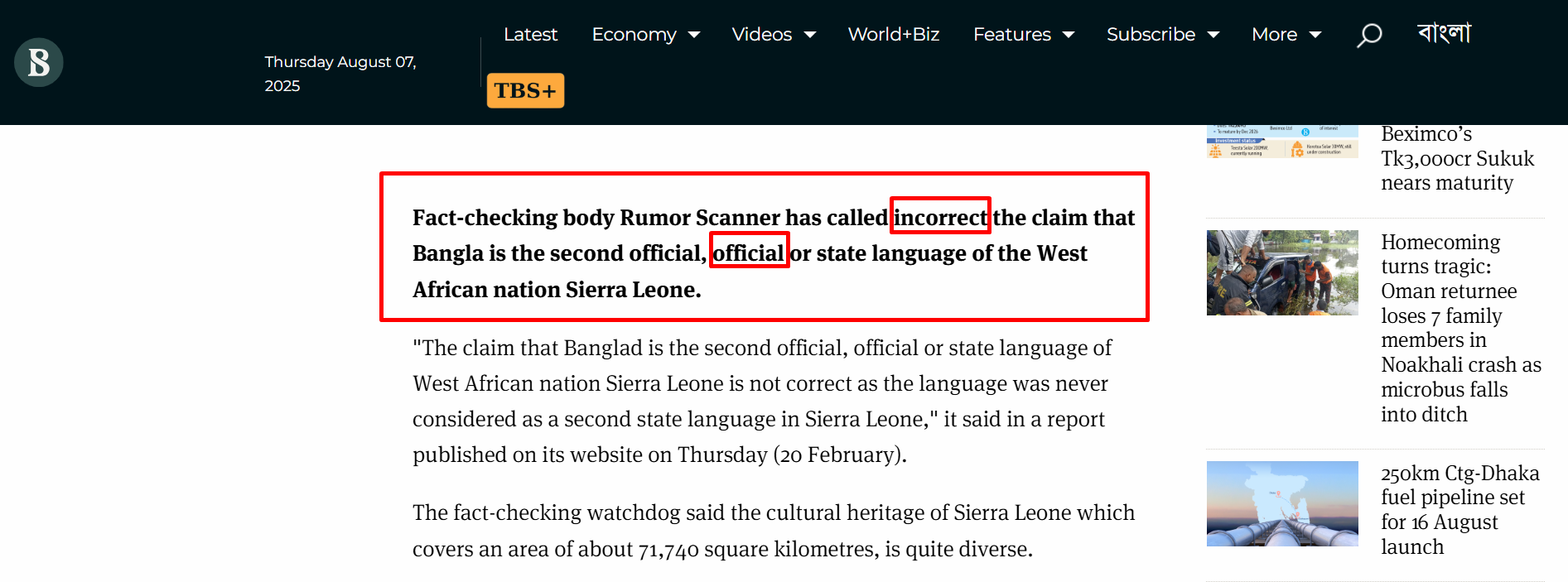
The claim that Bengali was declared an official language of Sierra Leone, often attributed to recognition of Bangladeshi peacekeepers’ contributions during the Sierra Leone Civil War (1991–2002), is incorrect. Sources like The Indian Express (2017) and GetBengal (2020) reported that Sierra Leone’s President Ahmad Tejan Kabbah declared Bengali an official language in 2002 to honor Bangladeshi UN peacekeepers. These reports suggested Bengali was used in schools, courts, and government offices, with children speaking it fluently. However, a 2023 Dubawa fact-check debunked this, confirming that English is Sierra Leone’s sole official language, inherited from its colonial history (Dubawa, 2023). No evidence supports Bengali’s use as an official language in Sierra Leone’s formal settings.
Dubawa cites an expert, Kargbo, who clarified that President Kabbah expressed appreciation for Bangladesh’s peacekeeping efforts (Bangladesh provided one of the largest UN contingents) and suggested Bengali be “considered or included” as a language in Sierra Leone, but not as an official language. This was a symbolic gesture, not a legal declaration. Sierra Leone’s linguistic diversity includes languages like Krio, Mende, and Temne, but none of these, nor Bengali, hold official status over English (World Atlas, cited in Dubawa, 2023). Claims of widespread Bengali use in Sierra Leone appear exaggerated, likely stemming from misinterpretations of Kabbah’s statements.
Verdict: The claim is false. Bengali was never declared an official language in Sierra Leone. President Kabbah’s 2002 statement was a symbolic gesture to honor Bangladeshi peacekeepers, not a formal declaration, and English remains Sierra Leone’s only official language.
Claim 3: Bengali’s Global Speaker Base and Cultural Significance Justify Its Inclusion as a UN Official Language
Fact-Check: Mostly True
Bengali is one of the world’s most spoken languages, with estimates of 272–350 million speakers, including 100 million in Bangladesh, 85 million in India (primarily West Bengal, Assam, and Tripura), and significant diaspora communities in the Middle East, Europe, and North America (Bureauworks, 2025; Britannica, 2025; Dhaka Tribune, 2024). It ranks as the fifth to seventh most spoken language globally, following Mandarin, Spanish, English, and Hindi (UN News, 2010; Bureauworks, 2025). Its literary tradition, spanning over 1,400 years, includes works by Nobel laureate Rabindranath Tagore, who wrote the national anthems of India and Bangladesh, and a vibrant Bengali Renaissance (Wikipedia, Bengali Language, 2025). The 1952 Bengali Language Movement, which led to UNESCO’s recognition of February 21 as International Mother Language Day in 1999, underscores its cultural and political significance (UN News, 2010; Wikipedia, Bengali Language, 2025).
These factors support arguments for Bengali’s inclusion as a UN official language, as advocated by Bangladesh and supported by India’s West Bengal, Tripura, and Assam assemblies (X post by @rajatsaha_, 2025). However, the UN’s criteria for official languages prioritize global diplomatic and administrative utility, as seen with the current six languages, which cover over 120 member states and 2.8 billion people (Quora, 2010). Bengali’s regional concentration in South Asia and the high cost of integration ($600 million annually) weaken its case compared to languages like Portuguese or Swahili, which also have UN Language Days (UN Official Languages, Wikipedia, 2010). Additionally, some sources note that Bengali’s dialects (e.g., Rarhi, Vangiya) and diglossia (Sadhubhasa vs. Chaltibhasa) complicate standardization for UN use (Britannica, 2025).
Verdict: The claim is mostly true. Bengali’s large speaker base (272–350 million) and rich cultural heritage, including its role in the Language Movement and literary contributions, justify advocacy for UN official status. However, practical challenges, including cost, regional concentration, and dialectal complexity, limit its immediate viability compared to existing official languages.
Claim 4: Bengali Is Actively Used in UN Communications as a Non-Official Language
Fact-Check: True
Following a 2022 UN General Assembly resolution sponsored by India, the UN Department of Global Communications was encouraged to use non-official languages, including Bengali, Hindi, and Urdu, for disseminating information (Dhaka Tribune, 2022; X post by @AmritMahotsav, 2022). As a result, the UN News website (news.un.org) provides translations in Bengali, alongside other non-official languages like Portuguese and Swahili, in addition to the six official languages (UN Official Languages, Wikipedia, 2010). This resolution built on earlier proposals to Kofi Annan and Ban Ki-moon to promote multilingualism (UN Official Languages, Wikipedia, 2010). The resolution does not confer official status but institutionalizes Bengali’s use for public outreach, reflecting its global significance.
Bangladesh’s historical engagement with the UN, including Sheikh Mujibur Rahman’s 1974 General Assembly speech in Bengali and the country’s role in establishing International Mother Language Day in 1999, further supports its visibility in UN contexts (Wikipedia, Bangladesh and the United Nations, 2018). However, this use is limited to communication materials and does not extend to official documents, simultaneous interpretation, or General Assembly proceedings, which remain exclusive to the six official languages (UN Official Languages, www.un.org, 2025).
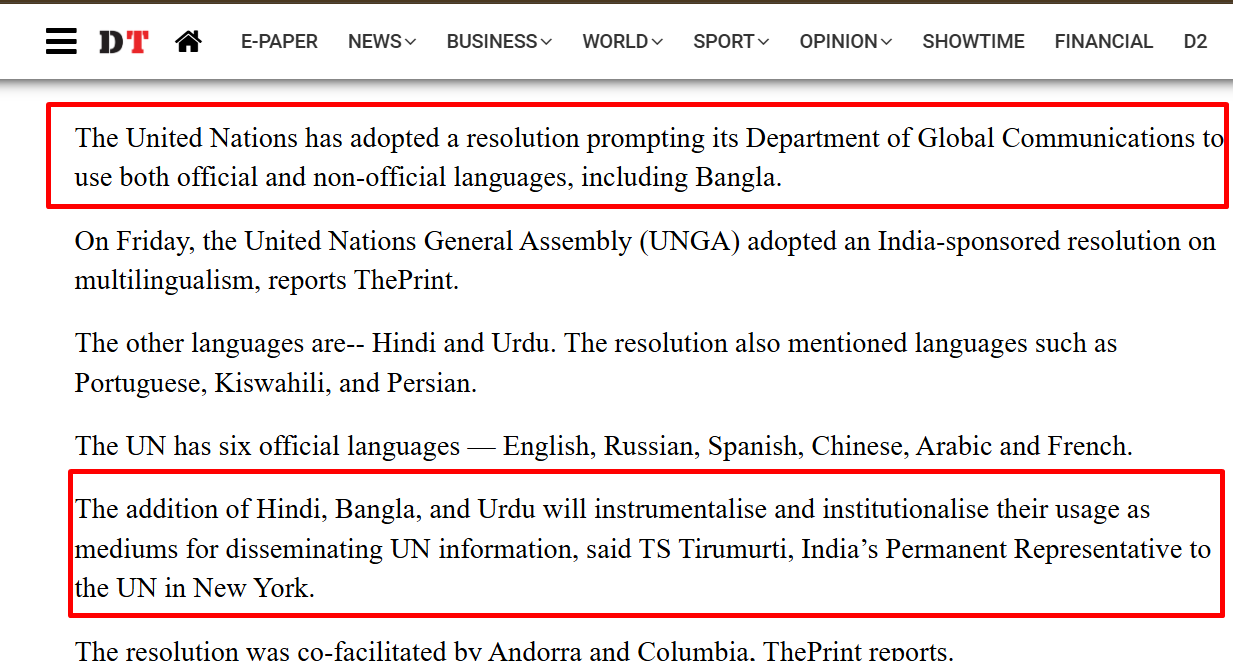
Verdict: The claim is true. Bengali is used as a non-official language in UN communications, particularly on the UN News website, following a 2022 resolution. Its use is limited to outreach and does not equate to official language status.
The Bigger Picture: A Language of Pride, Not Yet UN Official
Bengali, spoken by 272–350 million people, is a cornerstone of cultural identity in Bangladesh and India’s West Bengal, with a literary tradition spanning over 1,400 years and a pivotal role in the 1952 Language Movement, which inspired UNESCO’s International Mother Language Day (Wikipedia, Bengali Language, 2025). Bangladesh has consistently advocated for its recognition as a UN official language since 2009, supported by India’s regional assemblies, citing its speaker base and heritage (UN News, 2010; X post by @rajatsaha_, 2025). However, the UN’s six official languages cover the majority of member states, and adding Bengali would require significant financial resources ($600 million annually) and consensus, which has not been achieved (Dhaka Tribune, 2024). The 2022 resolution promoting Bengali as a non-official language for UN communications marks progress, but official status remains elusive (Dhaka Tribune, 2022). Claims of Bengali being an official language in Sierra Leone are false, stemming from a misinterpretation of a symbolic gesture (Dubawa, 2023). While Bengali’s global and cultural weight is undeniable, logistical and political barriers continue to limit its UN recognition.
The Skeptic’s Take
They keep saying Bengali’s a UN official language, but it’s not—plain and simple. It’s been Arabic, Chinese, English, French, Russian, and Spanish since forever, and adding a new one costs a fortune, like $600 million a year. Bangladesh has been pushing since 2009, with Hasina and others waving the flag for 300 million speakers and Tagore’s legacy, but the UN’s not budging. They let Bengali sneak into news translations in 2022, sure, but that’s just PR, not official status. And that Sierra Leone story? Total myth—Kabbah was just thanking Bangladeshi troops, not making Bengali their courtroom lingo. It’s a nice dream, but with dialects all over and cash-strapped UN budgets, Bengali’s stuck on the sidelines.
“They talk big about Bengali at the UN, but I’m still translating my own documents for visa applications,” I mutter, wondering if this is all just patriotic hype.
Conclusion
Bengali has not been declared an official UN language, despite advocacy from Bangladesh and India since 2009, driven by its 272–350 million speakers and rich literary tradition (UN News, 2010; Bureauworks, 2025). The UN’s six official languages remain unchanged, and financial barriers ($600 million annually) have stalled progress (Dhaka Tribune, 2024). A 2022 resolution promotes Bengali as a non-official language for UN communications, such as news translations, but it lacks official status (Dhaka Tribune, 2022). Claims of Bengali being an official language in Sierra Leone are false, based on a misread of a 2002 symbolic gesture (Dubawa, 2023). While Bengali’s cultural and demographic weight supports its case, logistical challenges and UN priorities make official recognition unlikely in the near future. Continued advocacy and UN reforms may shift this, but as of August 2025, Bengali remains a non-official language with limited but growing UN visibility.




