

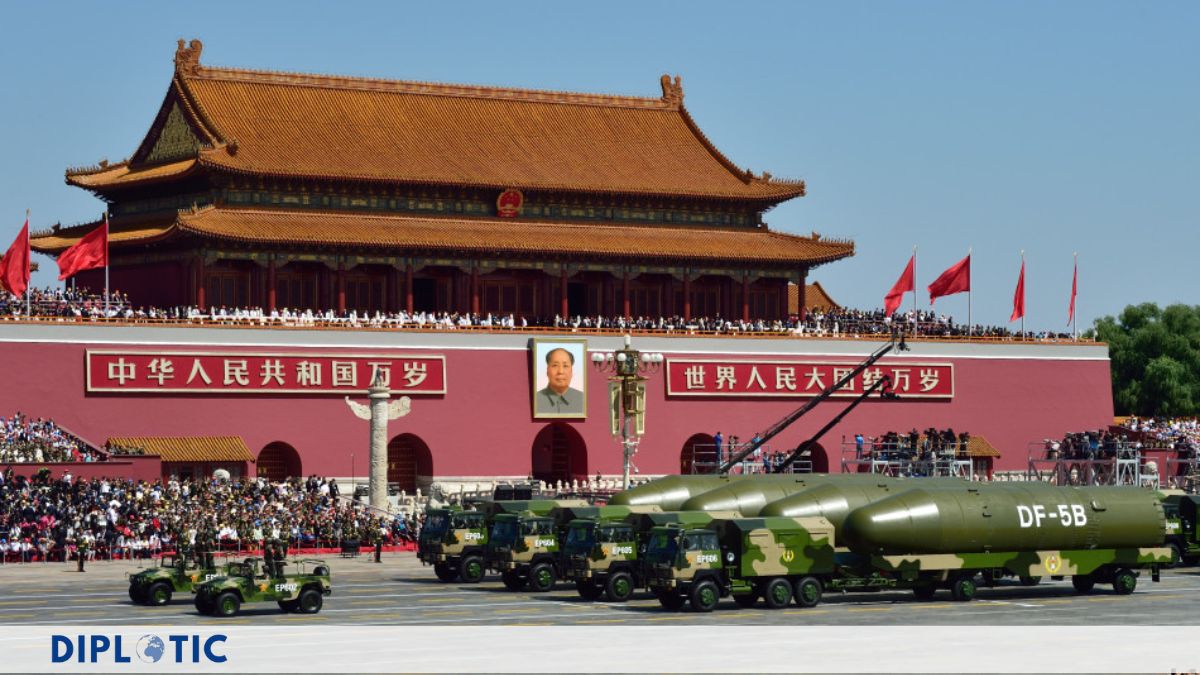
A Defiant Display: The Beijing Summit and Parade
On September 3, 2025, Beijing hosted a military parade marking the 80th anniversary of Japan’s defeat in World War II, alongside a Shanghai Cooperation Organisation (SCO) summit in Tianjin. Russian President Vladimir Putin, Chinese leader Xi Jinping, North Korean leader Kim Jong Un, and Iranian President Masoud Pezeshkian stood together, showcasing a coalition challenging Western dominance. Indian Prime Minister Narendra Modi attended the summit but not the parade, signaling a nuanced stance. The parade featured 12,000 troops, hypersonic weapons, and nuclear-capable missiles, projecting China’s military might. Xi’s vision, articulated at the SCO, pushes for a “Global South” led order, countering U.S. influence amid President Trump’s “America First” retreat.
Historically, such displays echo Cold War-era power blocs, but today’s alignment is pragmatic. Russia, isolated by Western sanctions post-2014 Crimea annexation, relies on China and India for oil revenue and dual-use tech, like chips in drones targeting Ukraine. Iran supplies Shahed drones, while North Korea offers manpower. The SCO, comprising China, Russia, India, and others, aims to rebalance global power. Europe, grappling with Russia’s 2022 Ukraine invasion, faces a shifting landscape. Posts on X note alarm at this “axis of upheaval,” fearing it emboldens aggression. If this coalition strengthens, Europe’s reliance on a wavering U.S. could weaken its defense, pushing NATO to adapt.
Economic Pragmatism Fuels Alliances
China and India’s neutrality in Ukraine masks economic support for Russia. Both nations, major buyers of Russian oil and coal, filled gaps left by Western sanctions, securing cheap energy. China, Russia’s top gas buyer after Europe, and India, hit by U.S. tariffs, share an anti-Western tilt, though not confrontation. Natia Seskuria of RUSI notes China’s ideological affinity for multipolarity, aligning with Russia’s push against U.S. dominance. India, balancing ties with the West, sees strategic gain in Russia’s Global South advocacy. Chinese firms supply dual-use tech, with U.S. Treasury data showing 70% of Russia’s drone components are Chinese.
This mirrors past economic alignments, like OPEC’s 1970s oil leverage, but today’s stakes involve military supply chains. The EU’s 2025 sanctions on Chinese banks aiding Russia sparked Beijing’s retaliation threats, escalating tensions. Europe, with a €305 billion trade deficit with China, faces pressure to de-risk. Yet, Ukraine and its allies hesitate to alienate Beijing or New Delhi, hoping they could pressure Putin for peace. If U.S. policy under Trump softens on China, as seen with Nvidia chip exports, Europe may face a fractured Western front, forcing reliance on its own economic and military tools.
Europe’s Security Reckoning
The Beijing events signal a long-term challenge to European security. John Lough of the New Eurasian Strategies Centre calls this a “re-engineering” of the global system, with Russia, China, and others exploiting U.S. withdrawal. Europe’s post-Cold War reliance on U.S.-led NATO is strained as Trump’s policies waver. Germany’s 2022 constitutional change for defense spending and Sweden-Finland’s NATO entry reflect Europe’s pivot. The International Institute for Strategic Studies reports a quadrupling of Russian attacks on European infrastructure in 2024, heightening fears.
However, the Sino-Russian-Indian axis is not ironclad. Iran’s unmet expectations during its 2025 conflicts with Israel and the U.S. highlight Russia’s limits. North Korea’s troop support is transactional, lacking public accountability. Lough notes this “alliance of interests” may shift, especially under Trump’s unpredictable term. Europe’s response—bolstering defense and reducing reliance on China’s rare earths—faces hurdles. The EU’s 2025 summit with China yielded vague climate pledges but no trade or security breakthroughs. If Russia’s war persists, Europe may need to activate tools like the 2023 Anti-Coercion Instrument, risking trade wars but signaling resolve. The parade’s message is clear: Europe must adapt or risk being sidelined.




