

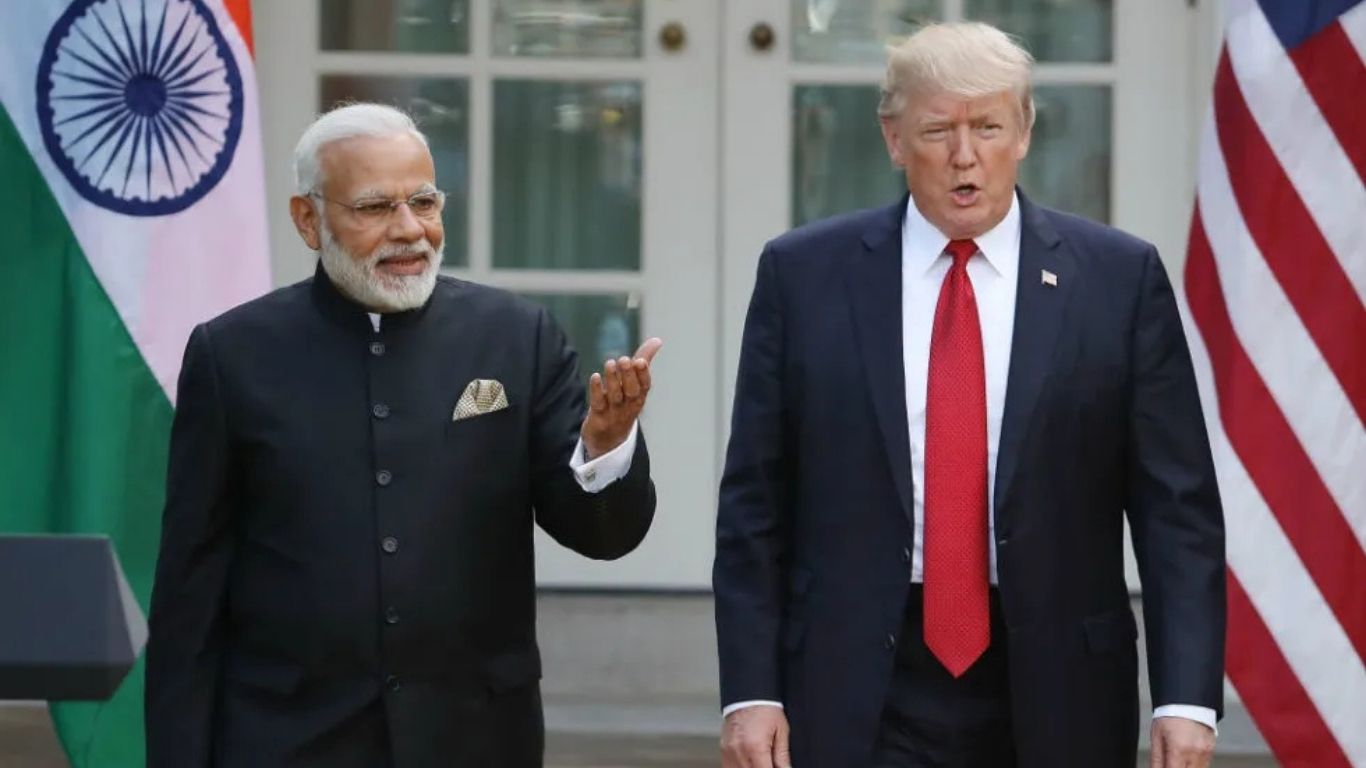
India finds itself in the crosshairs of a bold U.S. trade move as President Donald Trump has doubled tariffs on Indian goods to 50%, effective August 27, 2025, citing India’s continued purchase of Russian oil as a primary grievance. This escalation, announced on August 6, 2025, marks India as one of the most heavily taxed U.S. trading partners in Asia, alongside Brazil, and threatens to disrupt its $86.5 billion in annual goods exports to the U.S., which account for 18% of its total exports and 2.2% of its GDP. The tariffs, described by India as “unfair, unjustified, and unreasonable,” are seen as part of Trump’s strategy to pressure Russia over the Ukraine war by targeting nations that fuel Moscow’s economy. With just 20 days to negotiate before the new rates kick in, Prime Minister Narendra Modi’s government faces a critical juncture. Can India navigate this economic storm through diplomacy, strategic concessions, or retaliation? Or will it double down on its current stance, risking a trade war? This article explores India’s options, the potential fallout, and the broader implications for its economy, global alliances, and role as a China-plus-one investment hub.
The Tariff Shock: Why India?
The U.S. tariffs, comprising a 25% base rate effective August 7, 2025, and an additional 25% penalty for India’s Russian oil imports, are a sharp escalation from earlier threats. Trump’s executive order, posted on the White House website, justifies the additional tariff as a response to India “directly or indirectly importing Russian Federation oil,” which he claims undermines U.S. efforts to curb Russia’s war in Ukraine. India, now sourcing over 35% of its oil from Russia (up from less than 1% in 2021-22), defends these purchases as critical for energy security, arguing they stabilize global oil prices by reducing competition for Middle Eastern supplies. The Indian Ministry of External Affairs has called out the U.S. for selective targeting, noting that nations like the U.S. and EU also import Russian goods, such as uranium and LNG, yet face no similar penalties.
This move comes after months of stalled trade talks, with the U.S. pushing for greater access to India’s agriculture and dairy sectors—politically sensitive areas that employ over 45% of India’s workforce. Modi’s government has resisted, prioritizing farmer welfare, as seen in his August 2, 2025, speech in Varanasi, where he urged citizens to embrace “Swadeshi” (indigenous) products amid global economic uncertainty. Trump’s frustration was evident in his social media posts, calling India’s economy “dead” and its trade barriers “obnoxious,” a stark contrast to the warm rhetoric during Modi’s February 2025 White House visit, where the two leaders aimed to double bilateral trade to $500 billion by 2030.
Economic Fallout: A Looming Trade Embargo?
The economic stakes are immense. A 50% tariff could render most of India’s U.S.-bound exports—textiles, gems, jewelry, auto parts, and chemicals—commercially unviable. Nomura, a Japanese brokerage, warns that the tariffs could act as a “trade embargo,” halting affected exports and slashing India’s GDP growth by 0.2–0.4%, potentially pushing it below 6% this year. The Confederation of Indian Textile Industry’s Rakesh Mehra called the tariffs a “huge setback,” predicting a sharp decline in competitiveness against rivals like Vietnam, which faces a 20% U.S. tariff. While electronics and pharmaceuticals are currently exempt, labor-intensive sectors employing millions stand to suffer most.
Indian markets have already reacted. On August 7, 2025, the Nifty 50 and BSE Sensex fell 0.9% in early trading, and the rupee hit a five-month low of 87.6175 against the dollar. Exporters, particularly small and medium enterprises, are bracing for order losses, with the Federation of Indian Export Organisations estimating a 40–50% drop in U.S.-bound shipments. Former Reserve Bank of India governor Urjit Patel warned on LinkedIn that the tariffs could spark a “needless trade war” if talks fail, echoing concerns from analysts like Priyanka Kishore of Asia Decoded, who noted the disproportionate impact on domestic industries.
India’s Options: Diplomacy, Concessions, or Retaliation?
With the clock ticking, India has several paths to mitigate the tariffs, each with trade-offs:
- Diplomatic Push for a Trade Deal
Top-level diplomacy is India’s best shot at reversing or reducing the tariffs. A U.S. trade team is set to visit India in August 2025, offering a window to revive stalled negotiations. India has already made concessions, such as removing tariffs on industrial goods and allowing Elon Musk’s Starlink to operate, but the U.S. insists on access to agriculture and dairy markets. Modi’s government could offer phased tariff reductions on less sensitive sectors, like automobiles or whiskey, while maintaining its red line on farming. Jitendra Nath Misra, a former Indian ambassador, suggests Trump’s aggressive stance is a negotiating tactic, not a permanent policy. A deal could hinge on Modi personally engaging Trump, leveraging their past rapport to secure exemptions or lower rates. - Phased Reduction of Russian Oil Imports
To address the “Russia penalty,” India could signal a gradual shift away from Russian oil, aligning with its existing efforts to diversify energy sources. Russia’s share of India’s oil imports has already prompted domestic refining adjustments, with exports of refined products reaching Europe and the U.S. Dr. Chietigj Bajpaee of Chatham House notes that India’s pivot predates Trump’s pressure, suggesting room for symbolic cuts without alienating Moscow, a long-standing ally. However, a senior Indian official told Reuters that replacing Russian oil could spike global prices, a risk India is loath to take given its 1.4 billion citizens’ energy needs. - Retaliatory Tariffs and WTO Action
India could retaliate with tariffs on U.S. goods, such as oil, aerospace products, or chemicals, which dominate U.S. exports to India. In 2019, India imposed tariffs on 28 U.S. products, including apples and almonds, in response to U.S. steel and aluminum tariffs, only reversing them in 2023 after WTO disputes were resolved. Barclays Research sees retaliation as unlikely but not impossible, given this precedent. Alternatively, India could file a WTO complaint, arguing the tariffs violate fair trade principles, though this risks escalating tensions with Trump, who has dismissed multilateral frameworks. - Strengthening Alternative Alliances
Trump’s tariffs could push India closer to Russia and China, especially as Modi attends the Shanghai Cooperation Organisation (SCO) summit in 2025, his first visit to China since the 2020 Galwan clashes. Ajay Srivastava of the Global Trade Research Initiative suggests a revival of India-Russia-China trilateral talks to counter U.S. pressure. India could also deepen trade ties with ASEAN nations or the EU, though these markets can’t fully replace the U.S., its top export destination. This realignment carries risks, as it may alienate Western investors eyeing India as a China-plus-one hub. - Domestic Support for Exporters
To cushion the blow, India could bolster exporters through interest subsidies, loan guarantees, or export promotion programs. Commerce Minister Piyush Goyal is set to meet exporters to discuss relief measures, as shipments before August 21, 2025, are exempt from the additional 25% tariff. However, Nomura warns that current programs may fall short against a 50% tariff wall, urging more robust interventions.
Strategic Realignment: A China-Plus-One Setback?
India’s appeal as a China-plus-one destination—where firms like Apple diversify supply chains away from China—faces risks from the tariffs. While semiconductors and electronics remain exempt, higher costs for other exports could deter investors. Vietnam, with its 20% U.S. tariff rate, may gain an edge, though experts like Abhiram Eleswarapu of BNP Paribas argue India’s low export dependence (20% of GDP vs. Vietnam’s 87%) gives it bargaining power. Apple’s growing manufacturing base in India, producing a significant share of iPhones, is likely safe, but prolonged trade tensions could dampen broader investor sentiment.
Modi’s push for “Swadeshi” signals a focus on self-reliance, encouraging local production to offset export losses. This aligns with India’s broader economic strategy but may not fully compensate for the U.S. market’s loss. Krishan Arora of Grant Thornton Bharat emphasizes accelerating trade linkages with other nations to reduce long-term vulnerabilities, citing India’s diversified export markets (U.S. accounts for 18% of shipments).
Political and Geopolitical Angles
Domestically, the tariffs have sparked outrage. Opposition leader Rahul Gandhi called them “economic blackmail,” accusing Modi of a foreign policy failure. AIMIM chief Asaduddin Owaisi labeled Trump’s move “bullying,” questioning why Modi’s “56-inch chest” hasn’t countered U.S. aggression. The opposition’s narrative paints Modi as capitulating to Trump while failing to protect farmers, a key voter base. Modi’s defiance—vowing not to compromise on agriculture—resonates with rural voters but complicates trade talks.
Geopolitically, Trump’s tariffs expose tensions in India’s balancing act between Washington and Moscow. India’s Cold War-era ties with Russia, reinforced by arms supplies and public goodwill, clash with U.S. demands to isolate Putin. Trump’s favorable treatment of Pakistan, offering a 19% tariff rate and hosting its army chief, further irks Delhi, which rejects U.S. mediation on Kashmir. A potential India-Russia-China axis could reshape global alliances, but India risks alienating Western partners crucial for its tech and defense ambitions.
The 20-Day Window: Modi’s Biggest Test?
The next 20 days are pivotal. India’s restrained response—avoiding immediate retaliation—suggests a preference for diplomacy, but the stakes are high. A failure to secure a deal could cement the 50% tariffs, crippling exporters and slowing growth. Success hinges on Modi navigating Trump’s unpredictable style while protecting India’s core interests. As former trade official Ajay Srivastava advises, India should “remain calm” and avoid rash retaliation, focusing on meaningful negotiations.
The tariffs also test Modi’s global image. His “mega partnership” with the U.S., once a cornerstone of his foreign policy, now faces scrutiny. A deal that opens agriculture or dairy markets risks domestic backlash, while defiance could draw India closer to Russia and China, altering its strategic calculus. With markets jittery and exporters pleading for support, India’s choices will shape not only its economy but its place in a fractious global order.




