

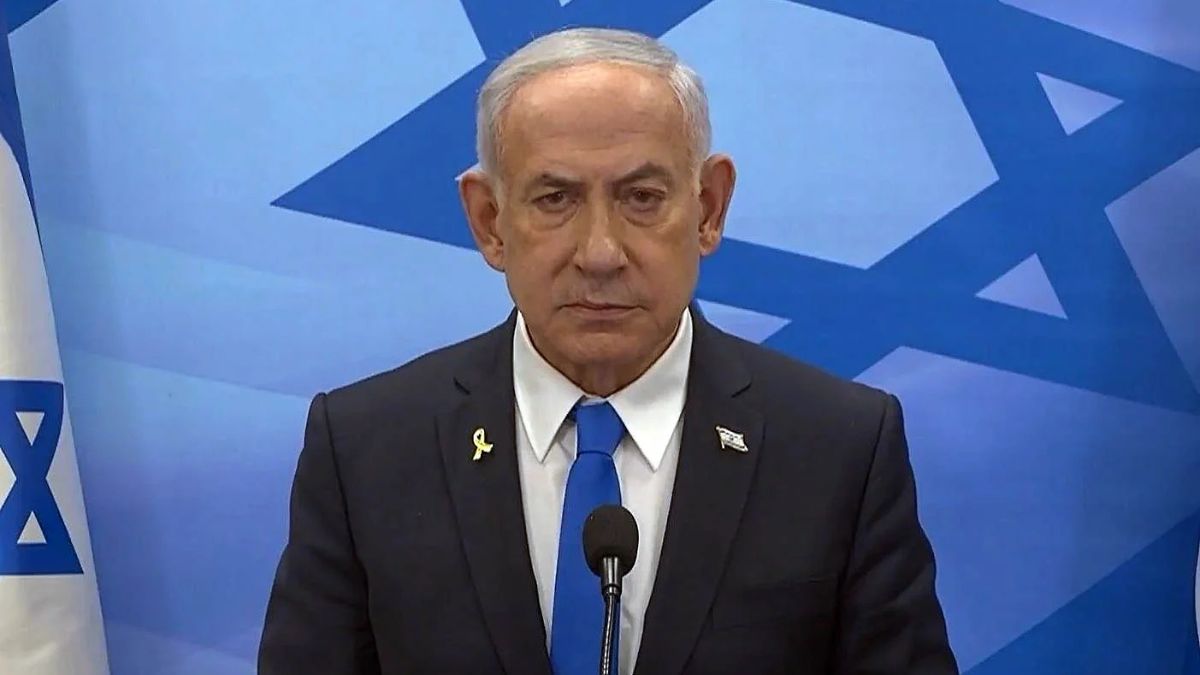
Israel’s unprecedented military strike on Iran’s nuclear sites marks a dangerous turning point. As Netanyahu fights for political survival, experts warn of catastrophic consequences and global fallout. In an explosive military maneuver that has stunned global leaders and shaken an already unstable Middle East, Israeli Prime Minister Benjamin Netanyahu has authorized a high-stakes military strike against Iran’s nuclear infrastructure. Dubbed “Operation Rising Lion”, the offensive marks Israel’s most audacious military action in recent history—one laced with biblical symbolism, nationalistic fervor, and political desperation.
Launched just hours after Netanyahu’s government narrowly avoided collapse over a controversial draft law targeting ultra-Orthodox Jews, the attack represents more than military aggression it is a political gamble designed to reshape Netanyahu’s fading legacy and unite a fractured nation.
But critics warn: this strike could ignite a catastrophic regional war, disrupt global oil markets, and set a dangerous international precedent by normalizing strikes on nuclear facilities.
A Calculated Crisis: Political Survival Through War
The timing of the operation was no accident.
Facing growing domestic unrest over military conscription inequality, a faltering economy, and mounting resentment over the Gaza conflict, Netanyahu chose to escalate diverting attention from internal chaos to an external “existential threat.”
“Netanyahu has long styled himself as Israel’s ultimate protector,” said Dr. Yael Feldman, a Tel Aviv-based political analyst. “This strike is as much about saving his career as it is about stopping Iran.”
Indeed, Netanyahu has built a two-decade political identity around Iran’s nuclear threat. From publicly rebuking President Obama in a 2015 U.S. Congress speech to helping dismantle the Iran nuclear deal with the Trump administration, Netanyahu’s “Mr. Security” persona is inextricably tied to Tehran.
Now, facing growing irrelevance on the world stage and a deeply polarized domestic base, the embattled Prime Minister is rolling the geopolitical dice.
Operation Rising Lion: Symbolism and Strategy
The naming of the strike “Rising Lion” draws from the Book of Numbers, where the prophet Balaam likens Israel to a lion that will not lie down until it devours its prey. This religious framing is not coincidental. It taps into a messianic narrative, invoking divine destiny and existential struggle to rally national support.
Such rhetoric reinforces Netanyahu’s alignment with the Israeli right-wing and religious Zionist movements, portraying the war not just as self-defense, but as a sacred mission.
But beneath the symbolism lies a military operation with grave global implications.
According to defense sources, the Israeli strike targeted multiple nuclear research sites and eliminated several top Iranian military officials and scientists. Though Iran has yet to fully respond, the possibility of radioactive fallout, retaliation, and escalation across Lebanon, Syria, and the Gulf is terrifyingly real.
Economic Collapse, Social Unrest, and the Price of Endless War
While war may temporarily galvanize national unity, the longer-term costs are already becoming apparent.
- Israel’s economy is stagnating under the weight of near-constant conflict.
- Tens of thousands of reservists have been pulled from civilian life for nearly two years.
- Inflation and the cost of living are surging, while tech investment is plummeting.
- Divides between secular Israelis and the ultra-Orthodox over military service are boiling over.
“Netanyahu is playing with fire,” said former Mossad official Amir Levanon. “This war could unify Israel for a week—but destroy it in a year.”
Meanwhile, the Israeli military has issued internal warnings of potential massive Iranian retaliation, including cyberattacks, missile barrages, and proxy attacks through Hezbollah and militias in Syria and Iraq.
Global Fallout: Diplomatic Isolation and Strategic Shifts
The strike has also accelerated Israel’s diplomatic freefall.
Once seen as a cornerstone of U.S. Middle East policy, Israel is now being increasingly sidelined. Former President Trump, who once championed Netanyahu, recently skipped Israel entirely on a tour of Gulf allies—an ominous sign of Israel’s diminishing strategic value.
More dangerously, Israel’s attack may have shattered international norms by directly striking nuclear facilities. Legal experts warn this could embolden other nations to follow suit, eroding decades of nuclear restraint.
“This is not just about Israel and Iran,” said UN disarmament official Leila Fakhouri. “This attack has global implications. It legitimizes a terrifying new military doctrine.”
A Legacy at Risk: Hero or Hubris?
For Netanyahu, this moment is the ultimate legacy test.
If the strike cripples Iran’s nuclear program without triggering large-scale retaliation, he will be hailed at least domestically as the defender of the Jewish state, a leader who did what others feared.
But the risks are astronomical. If Iran retaliates heavily, if nuclear contamination spreads, or if the war spirals out of control, Netanyahu may be remembered not as a hero but as a reckless architect of chaos.
In Washington, even Trump allies are reportedly cautious. While Trump praised Israel’s “bold defense,” insiders suggest that any Israeli interference in U.S. diplomacy, such as lobbying against a renewed Iran deal could strain ties.
Conclusion: A Precedent with No Exit Strategy
Israel’s strike on Iran marks a radical departure from its historical strategy of indirect confrontation. Unlike the 1981 bombing of Iraq’s Osirak reactor or the 2007 strike on Syria’s nuclear site, this operation occurred in an era of maximum regional volatility, dwindling international support, and unprecedented internal turmoil.
It is a bold, dangerous move one with no clear exit, no assured success, and potentially earth-shattering consequences.
As the world holds its breath, one truth emerges: Netanyahu has chosen to bet everything Israel’s future, regional stability, and his own political survival on a single, explosive act of war.




