

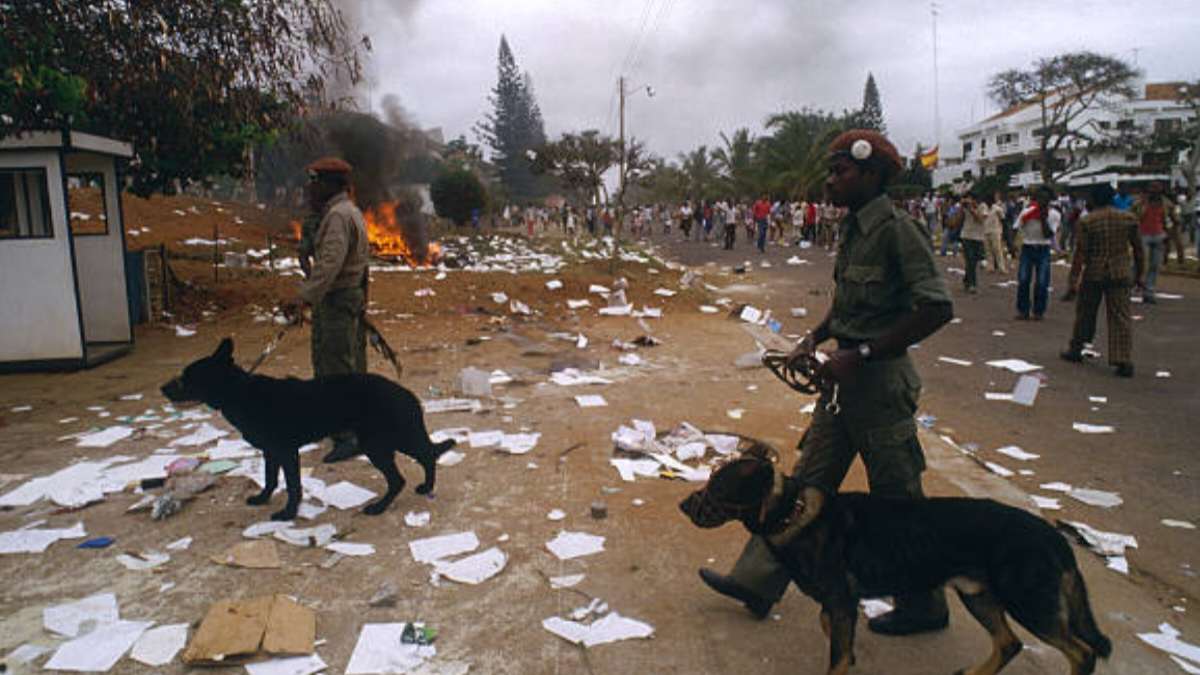
More than a month has passed since Mozambique’s violent general elections, which the opposition parties have disputed, and the country remains in a state of chaos. Innovative and rebellious forms of protest, such as nighttime “panelaco” protests or economic strikes, have become prevalent. These actions come at a time when a crisis has escalated, leading to loss of lives, disruption of sources of income, and degeneration of the economy.
The Sound of Resistance: Mozambique’s Panelaco
It was still 7 PM on the 4th of November in Maputo. There was hardly any movement on the roads since the previous day, and Mondlane continued to urge people to stay off their vehicles. Soon, residents of the high rises and inner city apartments chimed in with an organised and vigorous revolt, silenced by the beating of drums and the dull banging of spoons on pots that filled the air.
Thus, this panelaco—a pot-banging protest—has become a kind of expression of people’s frustration with the quite unaccredited election result without the use of which-way-to-turn actions against the powers that be. Many perceive it as a unifying force that transcends various registers and status levels, echoing through the city skyline every evening.
After the National Election Commission (CNE) announced that Daniel Chapo, the Frelimo candidate, had won 71% of the vote, the protests began. Independent candidate Venancio Mondlane obtained only 20% of the vote, yet he has rejected the election results, charging—quite rightly—massive fraud.
The assassination of Mondlane’s lawyer, Elvino Dias, on October 19 escalated the events. Dias had been at the center of preparing legal cases against the election results, which most voters believe are fraudulent. It only added to the public’s fury that he had died as well.
Nationwide Shutdowns: A Protest Strategy
Mondlane’s calls for the nation to shut down have resulted in significant disruptions. Houses, offices, schools, and even streets—from Maputo to the provincial capitals and the pivotal economic nodes, including border crossing points and sea ports—have ceased their daily operations.
In Ressano Garcia, near the South African border, the protest action led to the closure of the Lebombo border post—a key for the import/export of goods and people. Sectors were closed, employees were placed under lockdown, and demonstrations took place in American cities.
But the shutdowns have come with a bitter price: human lives. According to the NGOs, police violence has killed 30 people since the protests began. Note that border post disruptions shattered local economies in Mozambique and nearby South Africa, as the unrest also affected these countries.
The proscription is causing too many concerns in Mozambique and South Africa,” said Siphiwe Nyanda, South Africa’s high commissioner to Mozambique. They’re disrupting trade and day-to-day life in border towns such as Komatipoort, which rely so much on cross-border business.
Voices from the Frontlines
Those who participate in protests face greater risks. Henrique Amilcar Calioio, a university student in Maputo, has also participated in demonstrations to express his opposition to what he perceives as a discriminatory regime.
“The Calioio pot-banging represents the voice of the unheard,” Calioio said. At times, while peacefully protesting without causing any harm or damaging any property, we encountered tear gas and had to flee.
Calioio recalled one evening that police vehicles moving around the city fired tear gas into people’s houses, including his own.
Recalling the agonising experience of breathing in the gas
To claim that the protests have become a Libyan tamam: for schoolteacher Shireen Mohammed, they have rendered life impossible. While military vehicles and police trucks are now commonplace, the government’s Internet and phone signal blackouts have left her feeling isolated and powerless.
“It has been very chaotic,” she said. “Gunshots erupt, and we cannot even call or text our families to let them know we’re alive.”
Mohammed provided an explanation of the contribution that revealed Mondlane’s other side.
Simply put, given that Frelimo received 70% of the vote, why is everyone following Mondlane’s lead? she asked. Specifically, the protesters demonstrated how the actual election results are fake.
A Crisis Based on Economic Slowdown
Most analysts agree that the protests, although seen as an outcome of that election, are indicative of other socio-economic issues in the country.
Sam Jones, a senior researcher at the United Nations University, added that while the election served as the trigger, nearly a decade of economic stagnation has been the underlying issue.
“The society has developed a perception that the country is off track, and Mondlane has mobilized the youth in a way never seen before.”
However, the government’s response has been unforgiving. Executioners have used tear gas, rubber bullets, and live bullets on peaceful demonstrators, which many perceive as adding fuel to the fire.
He added that playing down these protests as ‘urban terrorism’ only serves to widen the gap even further. This has led to a great deal of resentment rather than effectively addressing the issue of unrest in the state.
The Economic Fallout
These protests are beginning to have an impact on Mozambique’s economic situation. There are fears that food shortages are imminent in Maputo, a city that primarily sources its supplies from South Africa.
“There is increasing concern with food security,” Jones added. “To emphasize, border shutdowns and disruptions in the supply chain have already resulted in product scarcity in supermarkets.”
Businesses in South Africa, for example, have also felt the impact. As stated by Gavin Kelly, the chief executive officer of the Virginia-based South African Road Freight Association, a day’s protest cost about 10 million Rand, which is $550,000.
Attacks have targeted over 150 shops in Mozambique alone, costing an estimated $369 million in damages. The economic losses have further exacerbated the already precarious situation.
Uncharted Territory: The Persistence of Protest
The intensity and duration of the protests are remarkable, especially considering that in Mozambique, protests following a disputed ballad typically last only a few days.
“This time the demonstrations have taken their own course,” said Jones. ‘They set agitative interests not only towards election problems but also towards the common problem of governance.
Although the Southern African Development Community (SADC) recently called for the holding of an emergency summit, the specifics of the additional actions and measures are still unclear.
To many Mozambicans, the noises of pots and pans at night represent frustration over the election and hope for a change at the same time.
Conclusion: Civilian Societies’ Preparedness When Going Tough
The protestation in Mozambique depicts the resultative fighting spirit of a nation that wants change. Despite drastic cuts to their food ration and attempts by the government’s armed forces to kill peaceful demonstrators, people continue to scribble on walls, protest, and express their dissatisfaction with their political leaders.
As the panelaco reverberates through the nights of Maputo, it serves as a powerful reminder: we can’t ignore the voice of the people demanding justice.




