


The claim that price manipulation by syndicates in Bangladesh is a significant driver of rising commodity prices, often labeled as a “myth” or “reality,” requires careful scrutiny. This fact-check evaluates the existence and impact of syndicates, their alleged practices (price-fixing, hoarding, and creating artificial shortages), and the broader economic context, drawing on available sources and maintaining a skeptical perspective on the narrative.
Claim 1: Syndicates Are Responsible for Price Hikes of Essential Commodities in Bangladesh
Fact-Check: Partially True, with Evidence of Syndicate Activity but Limited Proof of Widespread Control
Multiple sources, including The Financial Express, The Daily Star, and Dhaka Tribune, report that syndicates—groups of traders, wholesalers, or importers colluding to manipulate prices—are frequently blamed for price hikes in Bangladesh. The Bangladesh Competition Commission (BCC) claimed in 2023 that over 1,500 syndicates operate across various sectors, including food commodities, engaging in practices like price-fixing, hoarding, and creating artificial shortages. For example, rice prices rose by Tk 6–8 per kilogram and broiler chicken by Tk 30–40 per kilogram in late 2024, with syndicates allegedly exploiting supply chains to limit competition. The Bangladesh Poultry Association has accused corporate giants of manipulating egg prices by creating artificial shortages, with egg prices rising 15% in one month in 2024.
However, proving syndicate activity is challenging. The Daily Star notes that price manipulation is more feasible in markets with few dominant players (e.g., two or three major importers), but in competitive markets with thousands of sellers, forming cartels is difficult. Natural disasters, like three rounds of floods in 2024, caused significant crop losses, leading to supply shortages that naturally drove up prices for vegetables, eggs, and poultry. These supply-demand imbalances, coupled with high fodder costs and inadequate agricultural infrastructure, contribute significantly to price hikes, suggesting syndicates are not the sole driver. The official 2025 statement that actions against syndicates could disrupt supply chains further indicates their complexity and influence but also the difficulty of addressing them without evidence.
Verdict: Syndicates likely contribute to price hikes in specific sectors (e.g., poultry, rice), but their role is overstated compared to natural supply shortages and structural issues. Evidence supports some syndicate activity, but widespread control lacks definitive proof.
Claim 2: Syndicates Are Powerful Groups That Control Supply Chains and Evade Regulation
Fact-Check: True, but Their Power Is Enabled by Systemic Issues
Sources indicate syndicates often involve big importers, wholesalers, and sometimes retailers who exploit regulatory weaknesses, such as lax enforcement of competition laws and corruption within regulatory bodies. The Business Standard reported in 2023 that syndicates rely on corrupt officials to secure licenses and permits, allowing them to operate with impunity. The authority described syndicates as “big groups” with extensive business networks, suggesting they are powerful enough to disrupt supply chains if targeted. Political connections, particularly under the previous Awami League government, allegedly shielded syndicates, with ministers and traders linked to price manipulation.
However, the narrative of omnipotent syndicates may be exaggerated. The Financial Express argues that in a market with millions of consumers and thousands of sellers, forming a cohesive cartel is logistically challenging. Inadequate market information and supply chain inefficiencies (e.g., lack of storage and transport infrastructure) enable price manipulation by a few players, but this is more a symptom of systemic failures than syndicate dominance. The Bangladesh Securities and Exchange Commission (BSEC) faces similar issues with market integrity in capital markets, suggesting regulatory weakness is a broader problem.
Verdict: Syndicates exist and wield influence in certain markets, enabled by regulatory gaps and corruption, but their power is not absolute and is amplified by structural market weaknesses.
Claim 3: Government Efforts to Combat Syndicates Are Ineffective
Fact-Check: True
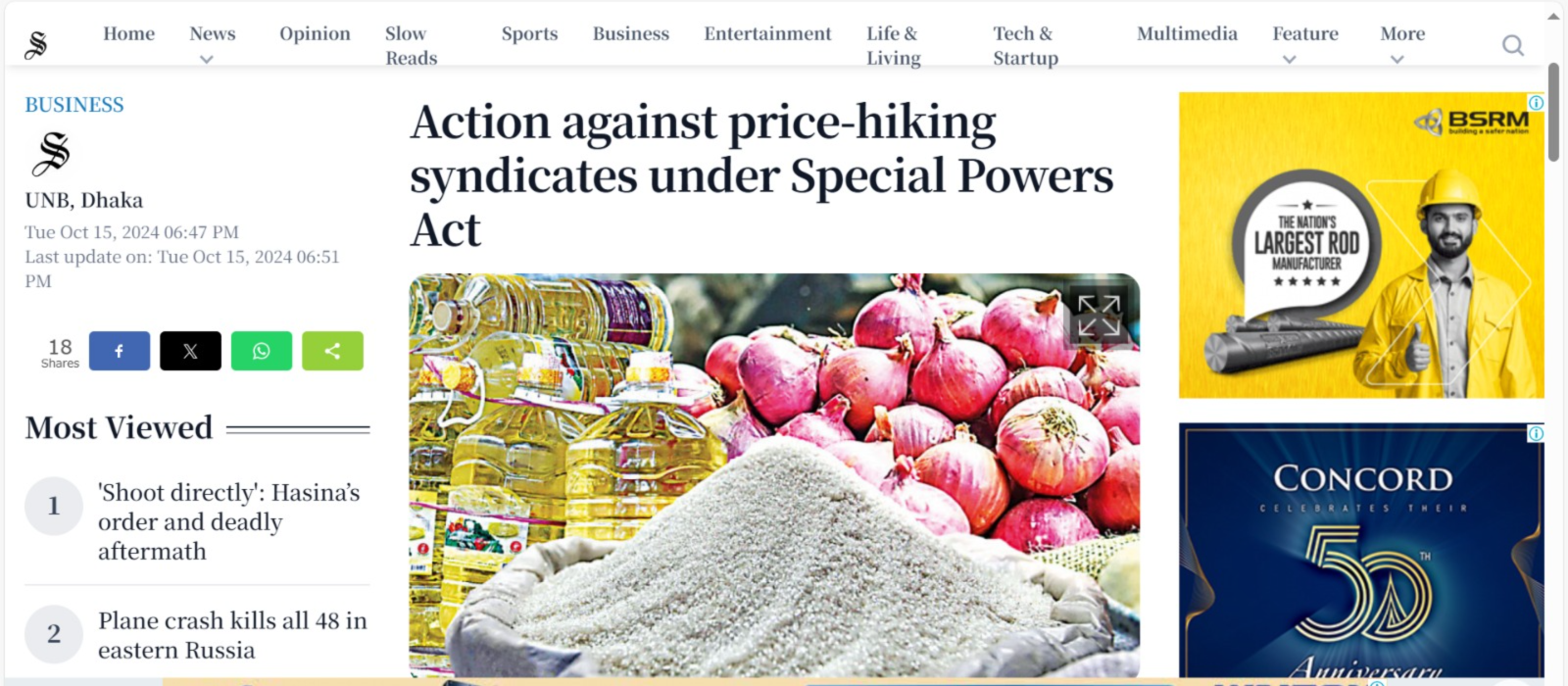
The interim government, in place since August 2024, has promised to tackle syndicates, with the labour and employment adviser, Asif Mahmud, announcing in October 2024 that key syndicate members could face arrest under the Special Powers Act. The government is also exploring alternative agricultural markets to bypass middlemen and syndicates, allowing farmers to sell directly. However, these efforts have shown limited success. The Financial Express notes that despite market monitoring by the Directorate of National Consumer Rights Protection (DNCRP) and student-led initiatives like non-profit sales centers in Khulna, prices remain volatile. The Consumer Rights Protection Act’s enforcement has been weakened, with small fines failing to deter syndicates.
Comparatively, countries like Malaysia and Thailand have implemented stricter laws, price ceilings, and task forces to monitor supply chains, achieving some success. Bangladesh’s competition commission exists but lacks robust enforcement, and corruption undermines regulatory efforts. The Trading Corporation of Bangladesh (TCB) has struggled to stabilize prices due to disruptions after removing politically connected dealers.
Verdict: Government efforts to combat syndicates are ongoing but largely ineffective due to weak enforcement, corruption, and entrenched market structures.
Claim 4: Price Hikes Are Primarily Due to Supply-Demand Imbalances, Not Syndicates
Fact-Check: Partially True
The Daily Star emphasizes that recent price surges (e.g., vegetables doubling or tripling in 2024) are driven by supply shortages from floods and heatwaves, not solely syndicates. For instance, egg production dropped from 4.5–5 crore pieces daily to 3–3.5 crore due to floods, against a demand of 4–4.5 crore. Meat prices, despite self-sufficiency (17.45 lakh tonnes produced annually against a 7.52 million-tonne demand), remain high due to costly fodder and supply chain inefficiencies. The Financial Express highlights illegal toll-taking and multiple supply chain markups as significant contributors to price hikes, independent of syndicates.
However, syndicates exacerbate these issues in concentrated markets. The New Age reports that syndicates in the poultry and rice sectors act like oligopolies, restricting supply to maximize profits, with egg and rice prices reflecting monopolistic tactics. The World Bank notes that only 30% of Bangladeshi households have access to competitive markets, enabling price manipulation in less competitive sectors.
Verdict: Supply-demand imbalances, driven by natural disasters and structural issues, are major factors in price hikes, but syndicates amplify costs in specific markets, particularly where competition is low.
Claim 5: Syndicates Are a Myth Fueled by Media and Public Perception
Fact-Check: False, but the Narrative Is Overblown
The Financial Express and The Daily Star argue that the “syndicate” narrative is partly a popular perception fueled by media and policymakers without sufficient evidence. Proving price-fixing requires rigorous investigation, as seen in U.S. antitrust cases, which Bangladesh lacks. The media’s tendency to blame syndicates for every price hike can obscure real issues like supply shortages or infrastructure gaps, diverting focus from actionable solutions. However, the BCC’s report of 1,500 syndicates and specific allegations against corporate entities (e.g., Kazi and Paragon in the egg market) indicate that syndicates are real, not mythical, though their scope is debated.
Verdict: Syndicates are not a myth, as evidence supports their existence, but their role is exaggerated by media and populist rhetoric, overshadowing other economic factors.
The Bigger Picture: Syndicates or Systemic Failures?
Price manipulation by syndicates in Bangladesh is a reality in concentrated markets like poultry, rice, and edible oil, where a few players can coordinate to fix prices or hoard goods. The BCC’s estimate of 1,500 syndicates and reports of corporate collusion in 2024–2025 provide credible evidence. However, the narrative overstates their dominance, as natural disasters (floods, heatwaves) and systemic issues—corruption, weak regulation, and supply chain inefficiencies—play significant roles in price hikes. The government’s response, including threats of legal action and alternative markets, has yet to yield results, reflecting entrenched interests and regulatory failures. International examples (e.g., Malaysia’s task forces) suggest stronger enforcement and competition policies could help, but Bangladesh’s market centralization and political ties complicate reforms.
The Skeptic’s Take
Syndicates are real but not the cartoonish villains they’re made out to be. A few big players in rice or eggs can nudge prices up, sure, but pinning every price spike on them ignores the floods washing out crops or the creaky supply chain jacking up costs. The government’s tough talk about busting syndicates sounds good, but when ministers and traders are cozy, it’s hard to see the hammer coming down. This feels like a convenient scapegoat for a market that’s messy, under-regulated, and reeling from nature’s punches.
Conclusion
Price manipulation by syndicates in Bangladesh is a reality, particularly in concentrated markets like poultry and rice, where evidence supports price-fixing and hoarding by major players. However, their impact is overstated compared to supply shortages from natural disasters, high input costs, and systemic issues like corruption and weak regulation. The government’s efforts to combat syndicates are ongoing but ineffective, hampered by enforcement gaps and political ties. While not a myth, the syndicate narrative is amplified by media and policymakers, risking distraction from broader structural fixes needed to stabilize prices.




