

Introduction: A Polarizing Legacy
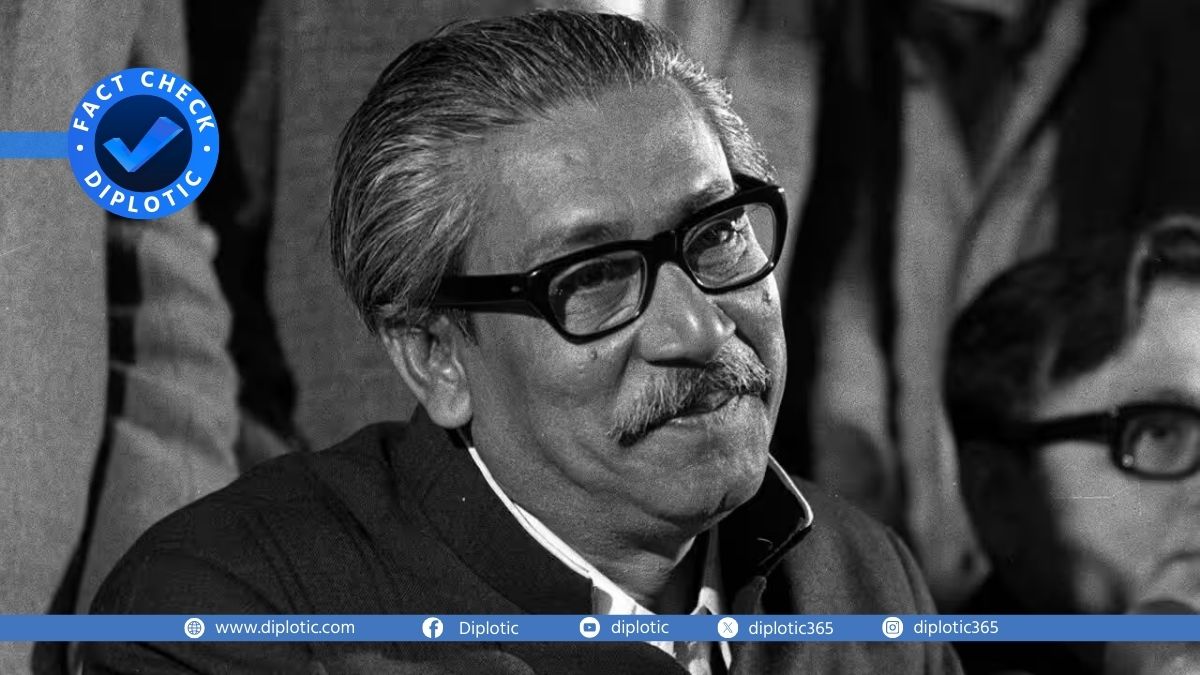
Few leaders in South Asian history evoke as much reverence and controversy as Sheikh Mujibur Rahman, the founding person of Bangladesh. To many, he was the “Bangabandhu” (Friend of Bengal), the man who led a liberation struggle against Pakistan in 1971. To others, particularly critics of his rule between 1972 and 1975, Mujib appeared as an authoritarian figure who dismantled democracy, silenced opposition, and centralized power in his own hands.
The question often arises in polemical debates: was Sheikh Mujibur Rahman truly a fascist leader of Bangladesh? To answer this, one must go beyond rhetoric and test his rule against comparative political-science definitions of fascism, while drawing on foreign scholarly assessments published during and after his tenure.
Defining Fascism
In order to fairly assess Mujib, we must rely on established scholarship. Robert Paxton, in The Anatomy of Fascism (2004), defines fascism as a mass-based authoritarian movement driven by ultranationalism, palingenetic myths of rebirth, organized violence, and corporatist economic control. Similarly, Juan Linz’s typology distinguishes between authoritarian regimes and totalitarian or fascist ones: fascism implies a mobilizing, revolutionary movement, not just power centralization.
Thus, the crucial test is whether Mujib’s Bangladesh (1972–1975) fits into the fascist paradigm, or whether it is better categorized as authoritarian one-party presidentialism.
Mujib’s Rule (1972–1975)
The Early Democratic Framework (1972–1973)
Following independence, Bangladesh adopted a parliamentary constitution (November 1972) guaranteeing multiparty democracy, fundamental rights, and press freedom. As Rounaq Jahan noted in Asian Survey (1974), the government initially sought pluralism but was quickly overwhelmed by factionalism, corruption, and weak institutions (“Bangladesh in 1973: Management of Factional Politics”).
Economic Crisis and the 1974 Famine
The new nation was struck by severe economic dislocation, inflation, and eventually the 1974 famine, in which hundreds of thousands perished. Talukder Maniruzzaman, writing in Asian Survey (1975), described this period as one of “economic crisis and political polarization,” where the government’s inability to stabilize food distribution eroded popular legitimacy.
The Turn Toward Authoritarianism (1974–1975)
- Special Powers Act (1974): Legalized detention without trial, widely criticized by human rights monitors.
- Rakkhi Bahini: A paramilitary force accused of extrajudicial killings and suppression of dissent (noted in foreign human rights reports and legal studies).
- Emergency Rule (1974): Civil liberties were suspended.
- Press Clampdown (June 16, 1975): The government banned all newspapers except four state-approved dailies—a move that Scholarly Journals on Media Freedom have repeatedly cited as a textbook case of authoritarian censorship.
The “Second Revolution” and BAKSAL (January–August 1975)
The most decisive authoritarian turn came with the Fourth Amendment (January 25, 1975), which:
- Replaced parliamentary democracy with a presidential system, concentrating power in Mujib’s hands.
- Created BAKSAL (Bangladesh Krishak Sramik Awami League) as the sole legal party.
- Suppressed political opposition and forced politicians, journalists, and civil servants to enroll in the one-party system.
As noted in Pacific Affairs (Robert S. Anderson, 1976), this marked the “virtual collapse of constitutional democracy” in Bangladesh and the beginning of a state-led party monopoly.
Assessing Fascism vs. Authoritarianism
Authoritarian Traits Present:
- One-party monopoly (BAKSAL).
- Suppression of free press and civil liberties.
- Use of paramilitary coercion (Rakkhi Bahini).
- Charismatic leader cult (“Bangabandhu”).
Fascist Traits Missing:
- No palingenetic ultranationalist ideology: Mujib’s nationalism was rooted in Bengali linguistic and cultural identity, not in a fascist-style myth of racial/civilizational rebirth.
- No corporatist economic restructuring: His policies leaned toward socialism and state-led planning, not corporatist syndicalism.
- No expansionist militarism: Mujib pursued non-alignment and peace with neighbors, contrary to fascist militarist aggression.
- No long-lasting mobilized movement: BAKSAL was created top-down in 1975 and collapsed within months after Mujib’s assassination on 15 August 1975.
As Paxton’s framework suggests, Mujib’s Bangladesh resembled a crisis-driven authoritarian presidency, not a fully-fledged fascist regime.
Scholarly Consensus
Foreign academic journals generally describe Mujib’s 1972–75 regime as authoritarian, not fascist:
- Asian Survey (1974–75): Documented Bangladesh’s drift from parliamentary pluralism to authoritarian centralization.
- Pacific Affairs (1976): Described the “rule of arms” after Mujib’s fall, highlighting the fragility of institutions.
- Comparative legal and media studies: Consistently cite the Special Powers Act and the press ban as authoritarian measures, not fascist doctrine.
Conclusion
Labeling Sheikh Mujibur Rahman a “fascist” oversimplifies history and misapplies a term with a specific comparative meaning. Between 1972 and 1975, Mujib indeed concentrated power, dismantled pluralism, and used authoritarian tools—moves well documented in foreign scholarship. Yet, his rule lacked the ideological, economic, and militarist hallmarks of fascism.
The most accurate description, as foreign journals and political-science frameworks agree, is that Mujibur Rahman presided over a brief authoritarian experiment in one-party presidentialism, not a fascist state.
Key Foreign References
- Rounaq Jahan, “Bangladesh in 1973: Management of Factional Politics,” Asian Survey, Vol. 14, No. 2 (1974).
- Talukder Maniruzzaman, “Bangladesh in 1974: Economic Crisis and Political Polarization,” Asian Survey, Vol. 15, No. 2 (1975).
- Robert S. Anderson, “Impressions of Bangladesh: The Rule of Arms and the Politics of Exhortation,” Pacific Affairs, Vol. 49, No. 3 (1976).
- Robert O. Paxton, The Anatomy of Fascism (2004).




