Arab and Muslim rulers enthusiastically endorsed Trump’s Gaza peace proposal, despite significant last-minute changes that favored Israel, silenced Palestinian voices, and erased meaningful prospects for Palestinian self-determination. An in-depth look into why regional powers risk undoing decades of Palestinian struggles in exchange for hollow promises of “peace.”
Introduction: Between Hope and Betrayal
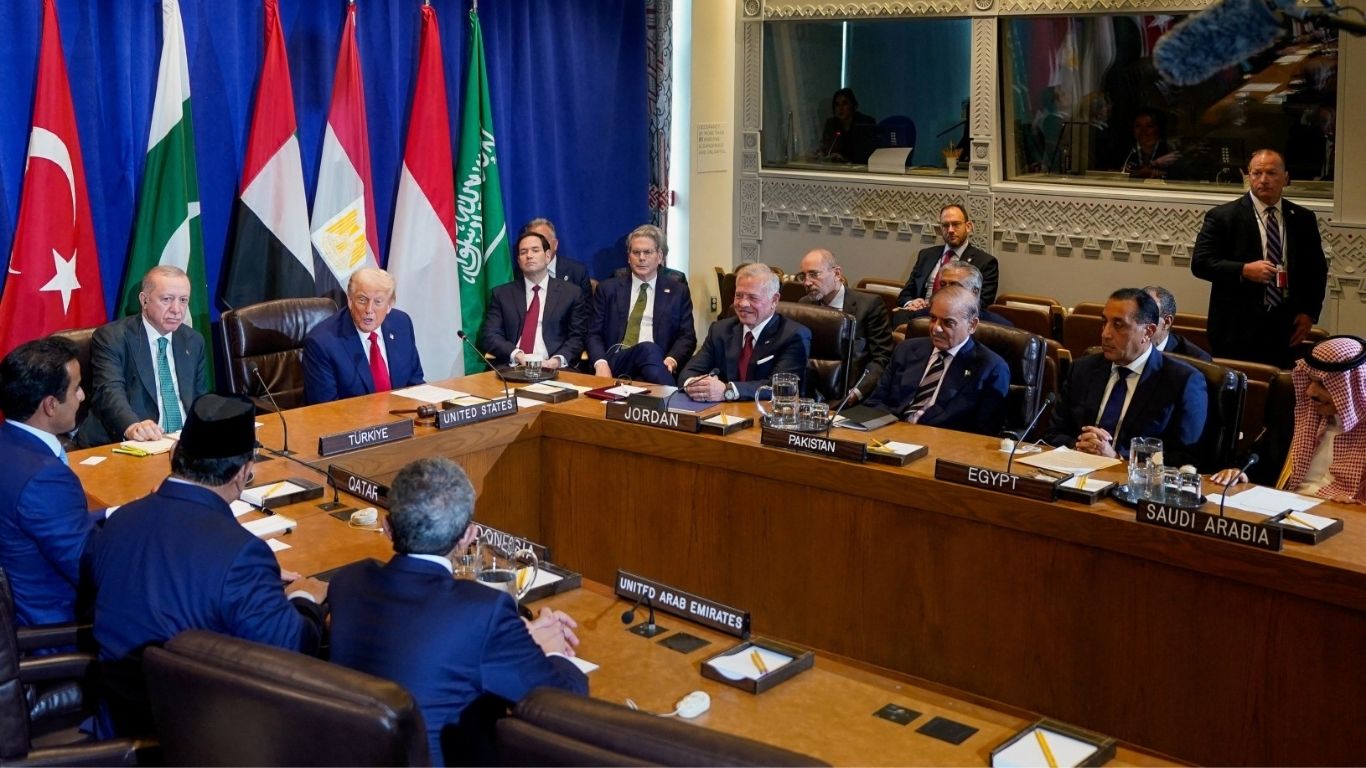
On the world stage, with media cameras rolling and aid convoys stalled, something crucial was traded this week: not just territorial lines or ceasefire rules, but values, trust, and a narrative of justice. Arab and Muslim leaders publicly welcomed US President Trump’s latest Gaza plan a deal ostensibly designed to end bloodshed, secure hostage swaps, and begin reconstruction.
But beneath the glossy press releases and sweeping international endorsements, there are worrying signs: many of the changes made to the agreement variant that was publicly embraced reveal a shift deeply unfavorable to Palestinians. Voices from Gaza and Ramallah are increasingly raw, accusing their supposed allies of betrayal.
This isn’t only about politics. It’s about whether regional moral leadership still matters and whether a people long overridden by international power politics can ever expect fairness.
What the Deal Promises and What’s Missing
The plan, announced in Washington and echoed in joint statements by eight Arab and Muslim countries (Egypt, Jordan, Saudi Arabia, UAE, Turkey, Qatar, Pakistan, and Indonesia), lays out major talking points:
- Immediate or near-immediate ceasefire and hostage releases.
- Demilitarization of Hamas.
- Governance of Gaza by an interim technocratic administration (i.e. Palestinians who are not Hamas), with international oversight.
- Israeli withdrawal to a proposed “agreed-upon” line, conditional on disarmament, security guarantees, and international monitoring.
Yet conspicuously absent from strong guarantees: a clear, enforceable timeline for Israeli withdrawal, full agency for Palestinian leadership, unambiguous recognition of a Palestinian state with rights to self-determination, or guarantees that territory and institutions will be unified with the West Bank under Palestinian authority.
From Drafts to Final Statement: Where the Concessions Happened
Reports reveal that early drafts of the agreement those circulated among Arab/Muslim leaders and US envoys contained stronger language about Israeli withdrawal, limits on Israel’s control, and guarantees for Palestinian governance. But the final version weakened a number of those elements:
- Removal of specific numerical targets (for example, how many trucks of aid per day) in favor of vague promises of “full support.”
- Conditional withdrawal of Israeli forces tied to “standards, milestones, timeframes,” leaving those terms to be negotiated, rather than fixed.
- Upgrade of conditionality on Palestinian Authority roles (e.g. reforms, dropping legal cases, modifying education and media) before gaining any meaningful powers.
Those shifts hardly minor turn what might have been a framework for accountability into something more malleable, where power remains unbalanced.
Regional Leaders: Why They Signed Up (and What They Gave Away)
1. Fear of being sidelined
Many Arab and Muslim regimes have faced accusations of irrelevance amid this conflict, seen as spectators rather than actors. Endorsing the plan gives them a seat at the table, some international legitimacy, and an opportunity to shape the post-war order even if in reality those seats may increasingly be symbolic.
2. Strategic & geostrategic trade-offs
Countries like Egypt, Jordan, Saudi Arabia, and the UAE have longstanding security, border, economic and diplomatic ties to both the US and Israel. They fear that rejecting this agreement outright isolates them from mediation, financial aid, investment, or influence. Accepting the deal even with reservations may be seen as a hedge.
3. Humanitarian pressure & domestic narratives
Leaders are under intense pressure at home: images from Gaza generate public grief and anger; international human rights institutions chant urgency for ceasefires and aid corridors. Signing on allows these leaders to claim they “took action” on stopping bloodshed, even while the fine print undermines those claims.
4. Dependence on external backing
Many states seeking superpower or donor engagement may see this plan as a sweet spot: not fully militant, not fully critical, but technical and managerial, giving them something to negotiate with Washington.
The Costs: What Palestinians Stand to Lose
• Shrinking sovereignty & political agency
With Hamas disarmed and Palestinian political institutions constrained by conditions, the ability of Gaza to self-govern or rejoin with the West Bank under a unified leadership becomes increasingly remote.
• Enduring presence of occupation
Even under the terms of the agreement, Israel retains the right to control borders, movement of aid and materials, security perimeters, and stay in strategic areas. Those elements amount to continuing features of occupation only more invisible.
• Conditional human rights & justice postponed
Release of prisoners, full rebuilding, restitution, access to services, rebuilding of infrastructure all becomes contingent on Palestinian compliance, as defined not by them but by parties they don’t fully control.
• The narrative of displacement
Though many countries oppose explicit forced displacement plans, the lack of firm protections in the deal leaves room for de facto dislocation through bureaucratic delay, infrastructural destruction, or lack of aid.
Could There Have Been Another Path? The Arab Counter-Proposals
In earlier months, there were serious alternative proposals: Egypt’s postwar plan, embraced by many Arab League members and later by the Organization of Islamic Cooperation (OIC), which emphasized that Palestinians must stay on their land, that governance should transition through Palestinian institutions, and that reconstruction be led by credible international mechanisms.
These counter-proposals were rejected (or outmaneuvered) by US and Israeli agents, side-lined in negotiations, or simply overtaken by the final Washington statement. The loss lies not only in agreement but in process: very few Palestinians, especially from Gaza, seem to have had meaningful input.
The Moral Question: Betrayal or Compromise?
Is this betrayal or an understandable compromise under harsh constraints?
For many Palestinians, any compromise that cedes their rights, dilutes their voice, or normalises occupation even under softer terms is betrayal. The symbolic weight of the Palestinian struggle is tied to self-determination, human rights, and justice.
For some leaders in the Arab and Muslim world, the calculation is painful but seen as pragmatic: war fatigue, global distrust of Hamas, the need for stability, the pressure of regional realpolitik.
But when compromise leads to erasure of voices, rights, or identity we cross from diplomacy into acquiescence.
What Now: What Must Change
1. Transparency and inclusivity – Palestinians, including civil society, Gaza leadership, must be part of drafting any agreement that affects their future. Without that, legitimacy suffers, compliance falters.
2. Clear, enforceable mechanisms – Timelines, benchmarks, verification mechanisms (with international involvement) must be non-negotiable. Anything vague gives room for delay, obstruction, backsliding.
3. Prioritize justice and self-determination – More than rebuilding roads and releasing hostages: rights to land, return, political participation, legal redress are central.
4. Regional leaders reassert moral agency – If public support and ethical alignment are important, regional powers must resist being used as rubber stamps. To preserve any moral credibility, opposition must sometimes be more visible and firm.
5. International community must hold all parties accountable – This includes international law bodies, donors, UN agencies; if promises are broken, consequences must follow.
Conclusion: The Long Shadow of a “Peace” Built on Unequal Terms
War has shattered lives, cities, futures. There is no doubt Gaza needs ceasefire, aid, reconstruction and urgently so. But peace built on conditions that strip agency, silence dissent, and retain control in the hands of already powerful actors isn’t peace it’s a transition of control dressed up as resolution.
Arab and Muslim leaders now stand at a crossroads. They can be remembered as voices that stood firm, that insisted justice accompany peace. Or they may instead be recalled as those who turned away when the camera was on, when the deal was done and when the price of speaking loudly seemed too high.
For Palestinians, and for anyone who believes in dignity under occupation, no deal is just unless it honours both life now and promise for the future.