

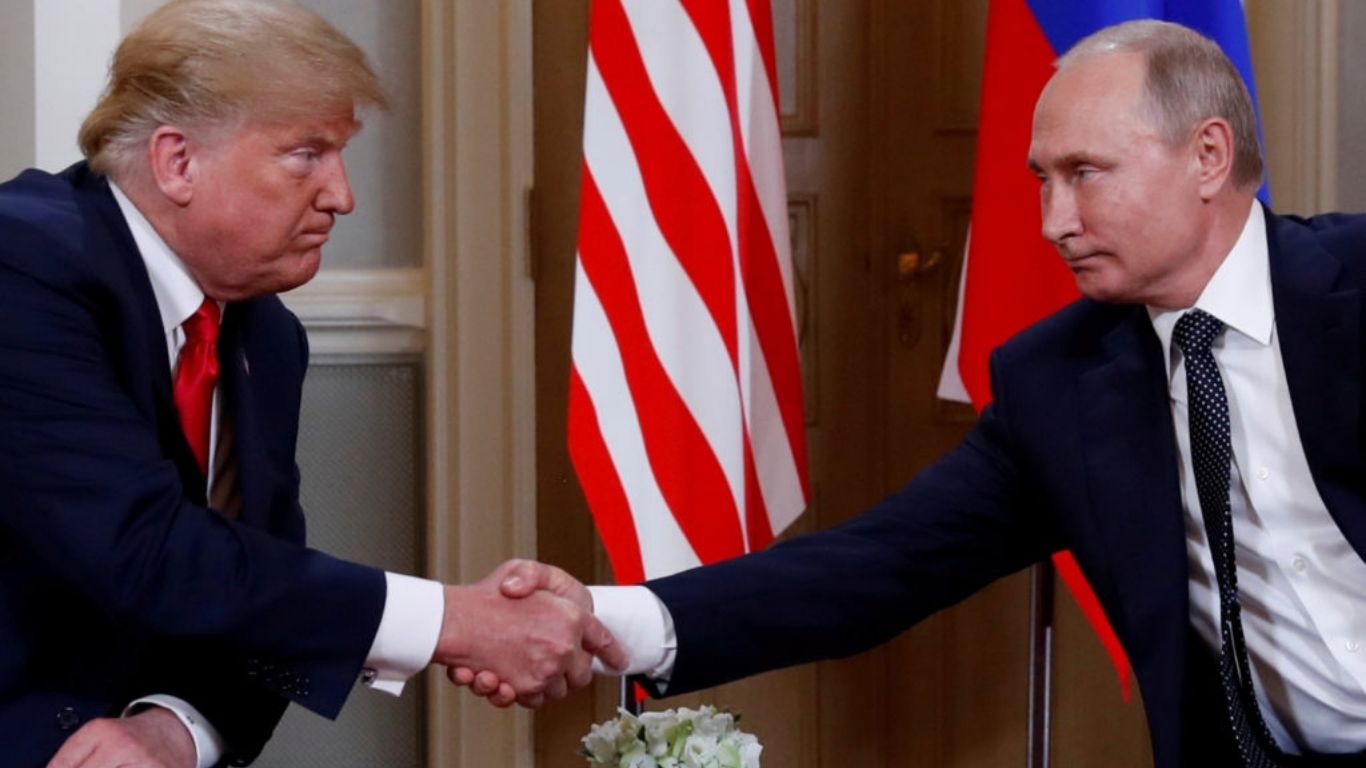
As the world watches with bated breath, U.S. President Donald Trump and Russian President Vladimir Putin convene today, August 15, 2025, at Joint Base Elmendorf-Richardson in Anchorage for a summit shrouded in mystery and high expectations. This face-to-face encounter, the first since Russia’s full-scale invasion of Ukraine in 2022, promises to tackle the grinding conflict that has reshaped global alliances and claimed countless lives. Yet, questions abound: Why this remote Alaskan outpost? What concessions might be whispered behind closed doors? And could this hurried dialogue truly pave the way for peace, or merely deepen divisions? With the war entering its fourth year, marked by recent Russian advances in Donetsk and Ukrainian counterstrikes on Russian soil, the stakes extend far beyond the Bering Strait, touching on energy markets, NATO’s future, and the very fabric of international order. This gathering, pieced together in mere days, invites scrutiny into its origins, implications, and the shadows of history that frame it.
Why Choose Anchorage: A Midway Point or Strategic Signal?
The decision to hold this pivotal meeting in Anchorage raises immediate curiosity about its practicality and symbolism. Announced just last week by President Trump, the location at Joint Base Elmendorf-Richardson emerged after a frantic search for a secure venue. Organizers considered other Alaskan spots but settled on Anchorage as the sole option capable of meeting stringent security needs, given its infrastructure and isolation. At roughly 4,300 miles from Moscow and 3,300 miles from Washington, D.C., it serves as a rough equidistant hub, minimizing travel burdens for both leaders while avoiding the political minefields of more central sites like New York or Geneva.
But practicality only scratches the surface. Alaska’s selection whispers of deeper geopolitical messaging, especially amid the Ukraine crisis where territorial claims echo historical disputes. This state, once under Russian control until the 1867 purchase for $7.2 million—a deal dubbed “Seward’s Folly” for its perceived extravagance—now hosts a dialogue that could redraw European maps. As explored in Britannica’s overview of Alaska, the transfer from Russia to the U.S. not only expanded American frontiers but also set the stage for enduring tensions across the Bering Strait, where islands like Little Diomede and Big Diomede lie just 2.5 miles apart, symbolizing proximity and division. During the Cold War, this frontier became a frontline, with Anchorage’s military installations pivotal in monitoring Soviet activities.
Investigating further, one finds parallel insights in how such venues influence negotiations. For instance, neutral or symbolic sites often soften adversarial tones, as seen in past U.S.-Russia talks. Here, the choice might signal Trump’s intent to “reset” relations, much like Obama’s 2009 efforts, while reminding Putin of lost imperial holdings. Yet, critics question if this distances Europe and Ukraine deliberately, sidelining allies in a conflict that has displaced millions and inflated global food prices. Local angles add layers: Anchorage, in peak tourism season, braces for an influx of 700 journalists and dignitaries, boosting the economy but straining resources. Flight restrictions from 9:15 a.m. to 4:15 p.m. today could delay commercial travel by 15 to 45 minutes, as noted by airport officials, prompting travelers to pad their schedules.
Moreover, the base itself carries weight. Established in 1940 amid World War II fears, Joint Base Elmendorf-Richardson merged Air Force and Army facilities in 2010, evolving into a hub for Arctic operations. Its role in intercepting Russian aircraft near U.S. airspace—incidents that spiked in 2024—underscores ongoing rivalries. Could this setting pressure Putin, or does it offer him a platform to project strength? Parallel to this, environmental concerns arise; the war’s fallout, including oil spills in the Black Sea, mirrors potential risks in the fragile Arctic ecosystem, where melting ice opens new shipping routes contested by both nations. As discussions unfold, Anchorage’s selection might prove a masterstroke or a misstep, blending history with hard-nosed strategy in ways that could redefine U.S.-Russia ties.
Tracing Footsteps: Putin’s U.S. Journeys and Alaska’s Untrodden Path
Delving into Putin’s history of U.S. visits reveals patterns that illuminate today’s summit. This marks his first trip to Alaska, a milestone for any Russian leader, but he is no stranger to American soil. His most recent foray was in 2015, attending the United Nations in New York for strained discussions with President Obama on Ukraine and Syria—echoes of which resonate now as the current war drags on. Earlier, in 2007, he met President George W. Bush at the family estate in Kennebunkport, Maine, amid missile defense disputes. A 2001 state visit spanned Washington, New York, and Texas, fostering post-9/11 cooperation that soon frayed. These encounters, often at multilateral forums, highlight Putin’s preference for high-profile stages to advance Russian interests.
Alaska, however, adds a fresh dimension, uncharted in this context. No Russian president has set foot here before, amplifying the event’s novelty. The state’s Russian heritage runs deep, from early 18th-century explorations by Vitus Bering to the 1867 sale, detailed in History.com’s account of the Alaska Purchase, where Secretary of State William Seward overcame mockery to secure the territory despite Civil War delays and congressional skepticism. Approved by the Senate 37-2 and funded by the House 113-43 in 1868, the deal proved prescient, yielding gold rushes and strategic advantages.
Presidential visits to Alaska offer comparative insights. Warren G. Harding was the first in 1923, part of his “Voyage of Understanding” that ended tragically with his death. Nixon hosted Japan’s Emperor Hirohito at Elmendorf in 1971, a refueling stop en route from China. Obama in 2015 ventured downtown for casual interactions, while Trump addressed troops at the base in 2019. These stops underscore Alaska’s role as a gateway, blending diplomacy with domestic outreach.
Investigatively, one wonders if Putin’s presence revives Cold War ghosts. The base, key in countering Soviet threats, hosted intercepts and exercises that persist today. Recent 2025 data shows increased Russian patrols near Alaska, prompting U.S. responses. This backdrop might embolden Trump to press for Ukraine concessions, or allow Putin to probe American resolve. Related angles include economic ties; Russia’s oil parallels Alaska’s, strained by sanctions that have redirected exports to Asia. Humanitarian parallels emerge too—the war’s refugees mirror Alaska Natives’ historical displacements. As Putin treads this new ground, his past visits suggest a pattern of seeking leverage, raising questions about what bargains he might strike amid shifting global powers.
Peering into the Talks: What Lies Beneath the Ukraine Focus?
At the heart of this summit lies the Ukraine war, a brutal stalemate that has evolved since 2022 into a test of endurance. Trump and Putin meet without Ukrainian representation, framing it as a “listening exercise” per White House statements, aimed at grasping paths to resolution. Expectations are tempered—no immediate ceasefire is anticipated, with Press Secretary Karoline Leavitt noting the absence of one key party. Yet, Trump’s hints at territorial swaps and swift deals clash with Putin’s insistence on securing gains, blocking NATO accession, and curbing Western arms.
Probing deeper, the agenda likely spans ceasefire terms, prisoner exchanges—like the 84 swapped on August 14—and long-term security. Russia’s recent captures of 241 square miles in July bolster Putin’s position, while Ukraine’s drone hits on refineries signal resilience. Investigative lenses reveal parallels to past negotiations; the 2014 Minsk accords, fragile and violated, warn of temporary fixes. Broader contexts include energy disruptions—the war has spiked prices, affecting U.S. consumers and Alaskan drilling debates.
What if hidden topics surface? Cybersecurity, with mutual accusations of hacks, or Arctic claims, where Russia’s militarization challenges U.S. interests. Diplotic.com’s analysis of us-russia-summits explores how such bilateral talks often mask multilateral pressures, as seen in Helsinki 2018 where Trump faced backlash for siding with Putin on election meddling. European allies, consulted last week, seek assurances, but exclusion fuels rifts.
Human costs demand attention: Over 200 civilian deaths in July 2025 from Russian strikes, per UN reports. Economic strains—Ukraine’s devastated grid versus Russia’s sanction-dodging—add urgency. Could Trump leverage tariffs on Russian buyers to force concessions? Or might Putin exploit U.S. divisions? These questions hook into larger angles, like Iran’s drone supplies to Russia mirroring North Korea’s arms, complicating global non-proliferation.
As talks proceed in one-on-one sessions followed by delegations and breakfast, outcomes remain elusive. Success might yield a framework including Zelenskyy soon, as Trump suggested. Failure could escalate, with Trump warning of consequences. This dialogue, against a backdrop of 600-mile frontlines, probes not just peace but power balances in a multipolar world.
On the Ground: How Security and Logistics Shape the Day
Logistics for this summit, assembled in a week, expose the challenges of high-level diplomacy in a remote setting. Both leaders arrive for a day trip, confined to the base—no excursions planned, ensuring focus amid tight schedules. Security ramps up: Anchorage police boost patrols from Thursday night, with extra presence at Ted Stevens International Airport. No street closures yet, but updates via state sites advise caution.
Air travel faces hurdles—a FAA restriction halts non-commercial flights, potentially delaying others. Airport spokespeople urge flexibility, as exact impacts clarify today. Schools near the base, resuming classes, anticipate minor traffic snags but minimal disruptions for Anchorage’s 40,000 students.
Investigating security, the base’s merger history enhances its suitability. Formed in 2010 from Elmendorf and Fort Richardson, it supports 13,000 personnel, ideal for secure ops. Cold War roots, as in the Library of Congress entry on the Alaska Purchase’s legacy, highlight its evolution from frontier outpost to strategic asset, guarding against Soviet incursions.
Related angles include tourism surges—peak season swells with summit visitors, straining hotels but aiding recovery from pandemic slumps. Economic parallels: Alaska’s resource economy mirrors Russia’s, both hit by climate shifts and sanctions. Environmental risks loom; increased military activity could impact wildlife, echoing war’s Black Sea pollution.
Public safety measures blend federal and local efforts, with APD estimating 700 media arrivals. This influx probes community resilience, from heightened alerts to economic boosts. As the day unfolds, these elements question if such haste compromises depth, or if the contained setup fosters candid exchanges.
Echoes Forward: Public Pulse and Lasting Shadows
Public reactions paint a divided picture, reflecting the summit’s controversy. Protests dot Alaska: Solidarity rallies for Ukraine in Anchorage, Homer, and Fairbanks, including a massive flag on the Park Strip today. A noon demonstration at 510 L Street voices democracy concerns, while the Alaska Republican Party rallies for Trump midday. These events, peaceful so far, underscore grassroots stakes in a war far away yet felt through inflation and alliances.
Broader implications tie history to now. Alaska’s sale, once ridiculed, proved vital in resource booms and defense. Today’s meeting, per Diplotic.com’s take on alaska-geopolitics, might similarly shift trajectories, perhaps easing tensions or exposing fractures. Voices like analysts warn of trans-Atlantic strains, with Europe sidelined.
Connecting past to present, this summit revives Cold War vigilance in an era of hybrid threats. If it sparks dialogue, it could heal Ukraine’s wounds; if not, prolong suffering. As Anchorage fades from headlines, the questions linger: Will peace emerge, or merely more uncertainty in a world forever linked across the strait?




