

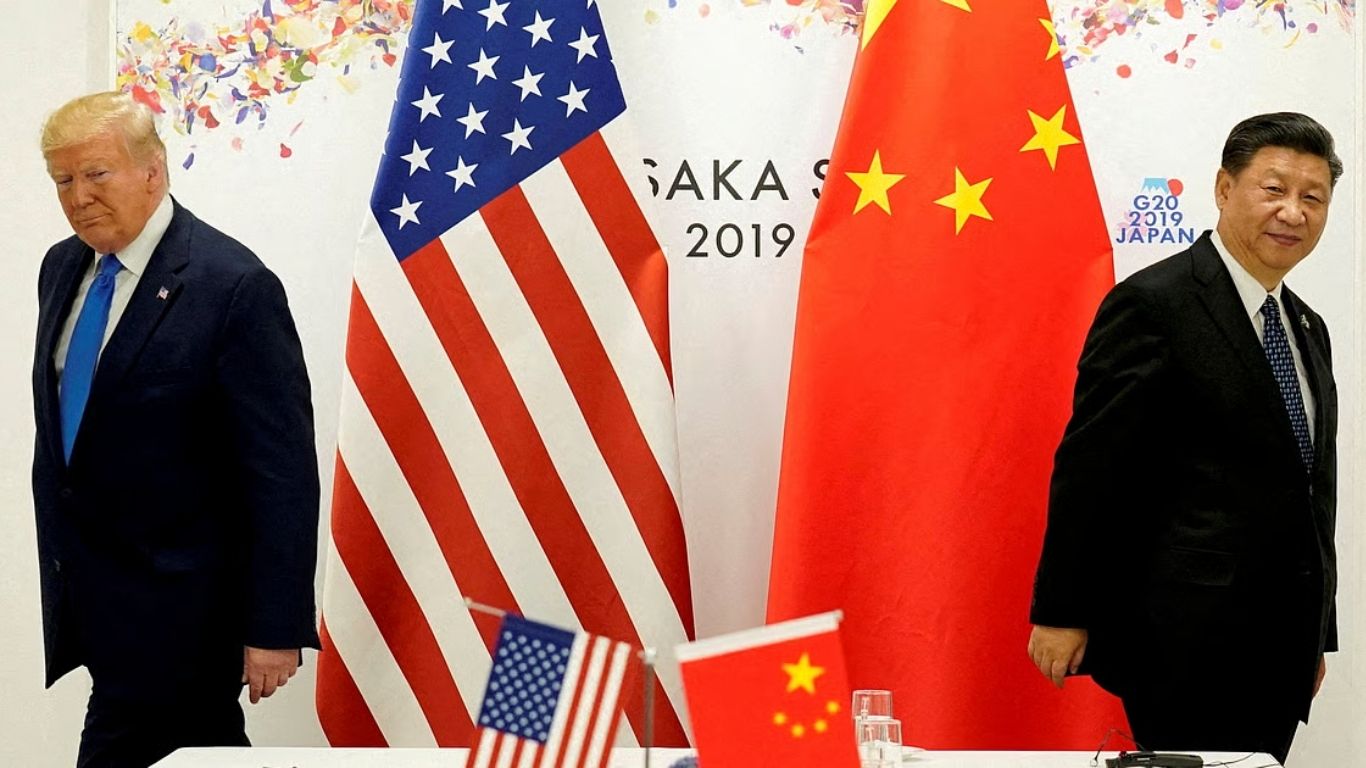
U.S.–China tensions over Taiwan resurface as Trump reveals assurance from Xi Jinping
U.S. President Donald Trump said Friday that Chinese President Xi Jinping personally assured him that Beijing would not attempt to invade Taiwan while Trump remains in office. The revelation comes amid heightened global concern over Taiwan’s security and just days before Trump is set to meet Russian President Vladimir Putin to discuss Moscow’s ongoing war in Ukraine.
In an interview with Fox News’ Special Report, Trump claimed Xi made the promise during recent conversations. “He told me, ‘I will never do it as long as you’re president,’” Trump said. “And I said, ‘Well, I appreciate that.’ But he also said, ‘I am very patient, and China is very patient.’”
Trump Reveals Assurance from Xi Jinping
The comments shed new light on Trump’s diplomatic engagement with China since starting his second presidential term. According to Trump, Xi conveyed the pledge directly during their first confirmed call in June and possibly during other conversations earlier this year.
“I don’t believe there’s any way it’s going to happen as long as I’m here,” Trump told Fox News, referring to a potential Chinese invasion of Taiwan.
Xi’s words, as described by Trump, appear to signal a temporary easing of fears about immediate military escalation in the Taiwan Strait. However, they also underscore Beijing’s long-term strategic patience regarding its claim over Taiwan.
China Reaffirms “One-China Principle”
The Chinese Embassy in Washington responded swiftly, reiterating Beijing’s position on Taiwan. Embassy spokesperson Liu Pengyu described Taiwan as “the most important and sensitive issue” in U.S.–China relations.
“The U.S. government should adhere to the one-China principle and the three U.S.–China joint communiqués, handle Taiwan-related issues prudently, and earnestly safeguard China–U.S. relations and peace and stability across the Taiwan Strait,” Liu said in a statement.
China has long viewed Taiwan as part of its territory and has not ruled out the use of force to achieve “reunification.” For Beijing, U.S. support for Taiwan remains a key flashpoint in bilateral ties.
Taiwan’s Reaction: Gratitude but Caution
While Taiwan’s government has yet to issue an official response to Trump’s remarks, senior officials expressed both appreciation and caution.
Wang Ting-yu, a legislator from Taiwan’s ruling Democratic Progressive Party and member of the defense and foreign affairs committee, welcomed U.S. support but stressed the need for self-reliance.
“Security cannot rely on the enemy’s promise, nor can it rely solely on the help from friends,” Wang wrote on Facebook. “Strengthening our own defense capability is fundamental!”
His statement reflects Taiwan’s consistent policy of investing in self-defense, even as it continues to rely on Washington as its primary arms supplier and international backer.
U.S. Policy on Taiwan: Strategic Ambiguity
The United States, like most countries, does not maintain formal diplomatic ties with Taiwan. However, Washington is Taiwan’s main arms supplier and most powerful international supporter. Under the Taiwan Relations Act, the U.S. commits to helping Taiwan defend itself, without explicitly promising direct military intervention in the event of a Chinese attack.
This policy of “strategic ambiguity” has defined U.S.–Taiwan relations for decades, aiming to deter both unilateral Chinese aggression and any declaration of formal independence by Taipei. Trump’s public disclosure of Xi’s assurance adds a new dimension to this delicate balancing act.
Geopolitical Context: Trump Balancing Russia and China
Trump’s remarks also come at a critical moment in global geopolitics. The U.S. president is preparing for high stakes talks with Russian President Vladimir Putin in Alaska, aimed at exploring ways to end Moscow’s war in Ukraine.
By highlighting Xi’s assurance on Taiwan, Trump appears to be framing his administration as capable of simultaneously managing two of America’s most complex adversaries: Russia and China. His comments suggest he views personal diplomacy as central to preventing conflict in both Eastern Europe and the Indo-Pacific.
What Xi’s Promise Really Means
Analysts caution that Xi’s reported pledge should not be interpreted as a permanent guarantee of peace across the Taiwan Strait. Instead, it reflects China’s tactical patience and long-term strategy.
Beijing has steadily expanded its military presence around Taiwan in recent years, conducting frequent naval and air drills. Even if Xi does not intend to move militarily during Trump’s presidency, the underlying dispute over Taiwan’s sovereignty remains unresolved and volatile.
The Bottom Line
Trump’s claim that Xi Jinping assured him China will not invade Taiwan while he is president injects fresh intrigue into U.S.–China–Taiwan relations. While the remarks may calm immediate fears of a crisis, they also highlight the fragile and uncertain nature of the Taiwan issue.
For Taiwan, Trump’s words are welcome but not a substitute for self-defense. For the United States, the challenge remains navigating support for Taiwan while maintaining a stable relationship with China. And for Beijing, the long game continues waiting patiently, building strength, and keeping the goal of “reunification” firmly in sight.




